Most businesses don’t replace their accounting software because they want more features. They replace it because the software they’ve relied on for years can no longer keep up.
As a business grows, finance teams often find themselves switching between spreadsheets, separate inventory systems, CRMs, ecommerce platforms, and banking applications just to complete routine tasks. Instead of saving time, they spend hours reconciling data and fixing manual errors.
That’s where NetSuite accounting software stands out. Rather than working as a standalone bookkeeping tool, it brings accounting together with the rest of your business, giving every department access to the same real-time information.
Before looking at its features, it’s worth understanding what makes it different from traditional accounting software.
What Is NetSuite Accounting Software?
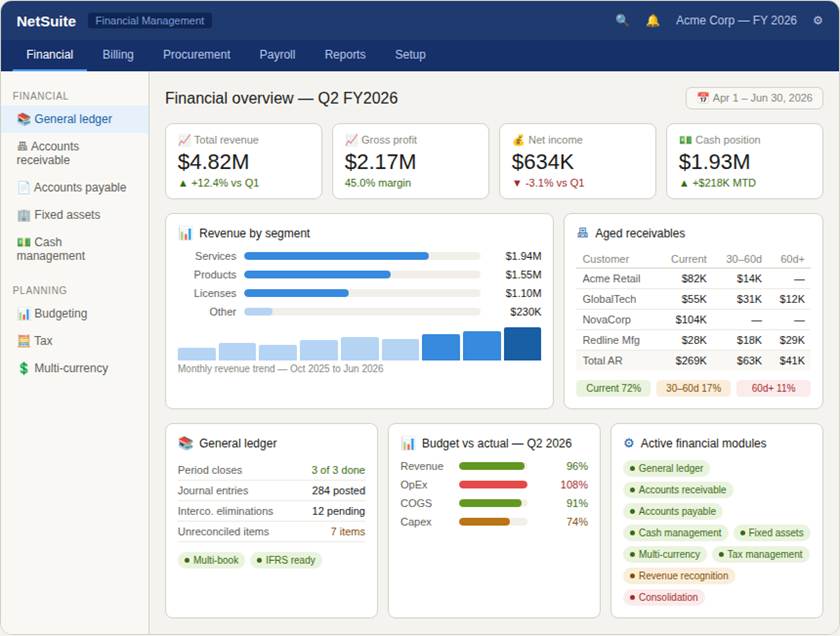
At its core, NetSuite accounting software is a cloud-based accounting platform that’s built into Oracle NetSuite ERP. Instead of handling only bookkeeping, it manages accounting, financial reporting, purchasing, inventory, order management, and other business processes from one system.
Because everything works together, information only needs to be entered once. For example, when a sales order is approved, inventory updates automatically, invoices are generated, and financial records stay up to date without moving data between different applications.
This is why many growing businesses choose NetSuite over traditional accounting software. It not only records financial transactions but also integrates accounting capabilities with the rest of the business, helping teams work more efficiently and make better decisions.
The Core Accounting Functions You’ll Use Every Day
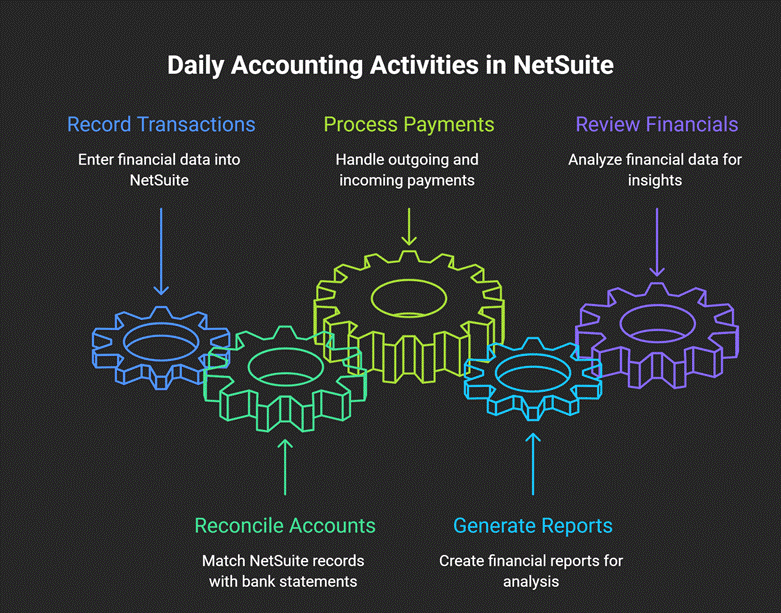
The accounting and finance modules of NetSuite ERP are designed to simplify everyday financial operations. Instead of relying on multiple systems, finance teams can manage routine accounting tasks from one centralized platform.
1. General Ledger
Automatically records financial transactions in one centralized ledger, giving finance teams a clear and accurate view of business performance.
2. Accounts Payable
Manage vendor bills, approvals, and payments while reducing manual processing and missed due dates.
3. Accounts Receivable
Generate invoices, track outstanding payments, and improve cash flow with automated billing processes.
4. Bank Reconciliation
Match bank transactions with accounting records faster, reducing reconciliation errors and manual effort.
5. Financial Reporting
Create real-time financial statements and customized reports without exporting data into spreadsheets.
6. Budgeting & Planning
Compare budgets against actual performance to make better financial decisions throughout the year.
| Traditional Accounting Software | NetSuite Accounting |
| Manual data entry | Automated workflows |
| Delayed reporting | Real-time dashboards |
| Separate business systems | Connected ERP platform |
| Spreadsheet-based analysis | Built-in analytics |
Beyond Bookkeeping: The Accounting Features Growing Businesses Actually Need
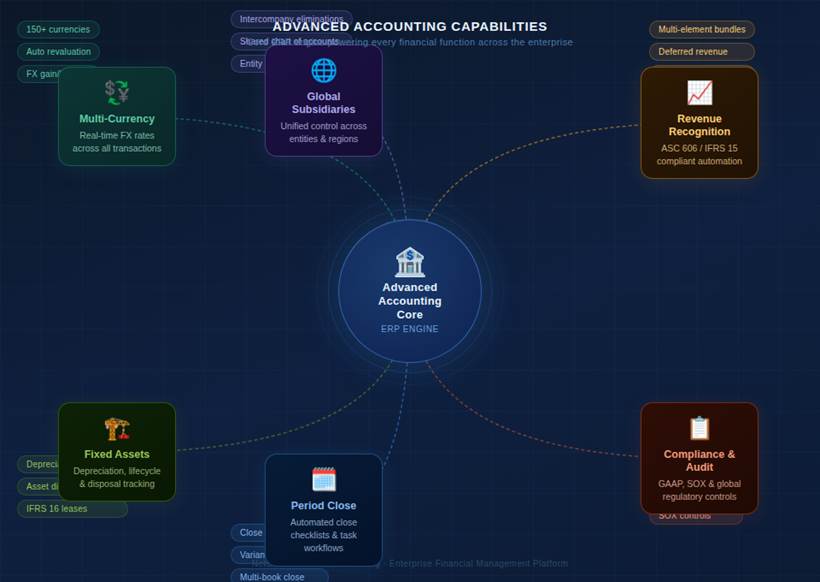
As businesses expand, accounting becomes more than recording transactions. Managing multiple companies, currencies, tax rules, and compliance requirements manually can quickly become overwhelming.
This is where the advanced capabilities of the NetSuite accounting system make a noticeable difference.
1. Multi-Entity & Multi-Currency Accounting
If your business operates across different locations or countries, NetSuite allows you to manage multiple subsidiaries and currencies from one system while automatically consolidating financial data.
2. Revenue Recognition
Revenue doesn’t always need to be recognized the moment a sale is made. NetSuite automates revenue recognition based on accounting standards, helping finance teams stay compliant while reducing manual calculations.
3. Fixed Asset Management
Track company assets throughout their lifecycle, calculate depreciation automatically, and maintain accurate financial records without relying on spreadsheets.
4. Tax Management
NetSuite supports tax calculations across different regions, making it easier for businesses operating in multiple jurisdictions to stay compliant.
5. Audit Trail & Compliance
Every financial transaction is automatically recorded with a complete history of changes. This improves transparency and simplifies internal audits.
How NetSuite Connects Accounting With the Rest of Your Business?
One of the biggest advantages of NetSuite isn’t just its accounting features, it’s how they connect with the rest of your business. Instead of moving data between separate applications, NetSuite keeps departments working from the same source of truth.
Here’s how information typically flows through NetSuite:
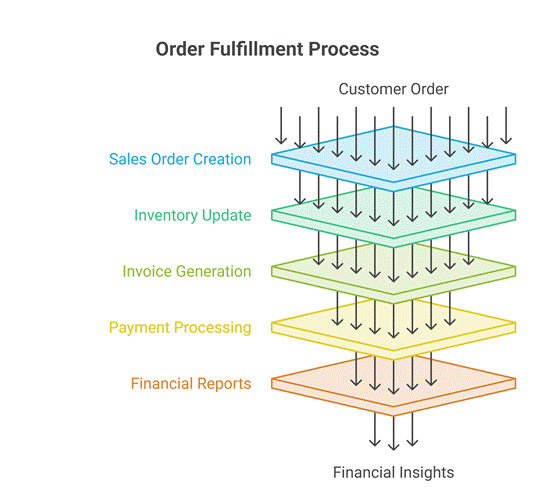
This is why many organizations choose to integrate NetSuite with CRM systems, automate business processes, and connect third-party applications through NetSuite integration services as they continue to grow.
Is NetSuite Accounting Software the Right Fit for Your Business?
Not every business needs an enterprise accounting platform. The right choice depends on your size, complexity, and future growth plans.
| NetSuite Is a Good Fit If You… | You May Not Need It Yet If You… |
| Manage multiple entities or locations | Only need basic bookkeeping |
| Sell through multiple sales channels | Have a very small business |
| Need real-time financial reporting | Have simple accounting workflows |
| Manage inventory and purchasing | Don’t expect significant growth |
| Require approval workflows and automation | Only use accounting for tax filing |
If your finance team spends more time updating spreadsheets than analyzing business performance, it may be a sign that you’ve outgrown traditional accounting software.
Exploring NetSuite ERP implementation, financial automation, and cloud ERP solutions can help determine whether it’s the right next step for your business.
What Affects NetSuite Accounting Pricing?
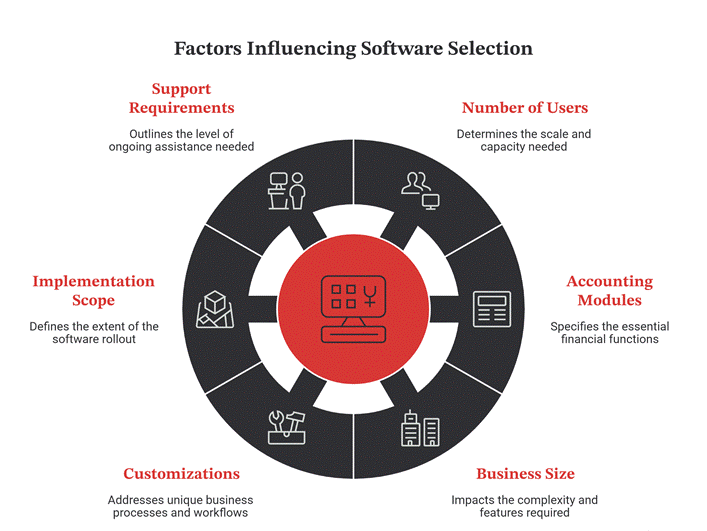
There isn’t a fixed NetSuite Accounting price because every business has different requirements. The final cost depends on the features you need today and how your business is expected to grow in the future.
Rather than focusing only on the initial investment, consider the long-term value of automating financial processes and reducing manual work.
More Accounting Tools That Help Finance Teams Work Smarter
Beyond its core accounting features of cash flow management, NetSuite includes specialized tools that support businesses with more complex financial requirements.
1. Multi-Book Accounting
Manage multiple accounting books within the same NetSuite account, making it easier to meet different reporting standards and regulatory requirements.
2. Outsource Bookkeeping & Accounting with Folio3 + SMB Services
Businesses that don’t have an in-house finance team can rely on Folio3’s bookkeeping and accounting services to manage day-to-day accounting while getting the most value from their NetSuite investment.
Choosing the Right NetSuite Accounting Partner
Buying software is only one part of the journey. The right NetSuite accounting partner helps you configure the platform, migrate financial data, train users, and provide ongoing support as your business grows.
Look for a partner that can:
✔ Understand your accounting processes before recommending a solution.
✔ Help with NetSuite implementation, customization, and future upgrades.
✔ Support integrations with CRM, ecommerce, payroll, and other business applications.
✔ Offer ongoing optimization instead of only fixing issues when they occur.
✔ Have experience with businesses in your industry.
Why NetSuite Folio3?
Choosing the right accounting platform is only part of the equation. At NetSuite Folio3, we help businesses implement, customize, integrate, and optimize NetSuite so their finance teams can work more efficiently from day one. Whether you’re adopting NetSuite for the first time or looking to improve your existing setup, our experts can help you get the most from your investment.
Final Thoughts
NetSuite accounting software is much more than a tool for recording financial transactions. It gives businesses a connected platform where accounting, operations, and reporting work together, helping finance teams spend less time managing data and more time making strategic decisions.
In my opinion, the biggest advantage isn’t any single feature, it’s having every financial process connected in one place. As your business grows, that visibility becomes just as valuable as the software itself.
Frequently Asked Questions
1. Can NetSuite Accounting work with my existing CRM or ecommerce platform?
Yes. NetSuite integrates with many CRM, ecommerce, payroll, and third-party business applications, allowing data to flow between systems without manual data entry.
2. How long does it take to implement NetSuite Accounting?
Implementation timelines vary depending on your business size, data complexity, and customization requirements. Standard implementations can take a few months, while larger projects may take longer.
3. Does NetSuite Accounting support different accounting standards like GAAP and IFRS?
Yes. With features like Multi-Book Accounting, NetSuite can support multiple accounting standards and reporting requirements within a single system.
4. Can I customize NetSuite Accounting to match my business processes?
Absolutely. You can customize dashboards, approval workflows, reports, forms, and automations to fit your company’s financial processes.
5. Is my financial data secure in NetSuite?
Yes. NetSuite includes role-based access controls, audit trails, data encryption, and regular security updates to help protect sensitive financial information.
6. Can NetSuite Accounting automate recurring financial tasks?
Yes. It can automate recurring invoices, journal entries, approvals, revenue recognition, bank reconciliation, and many other routine accounting processes.