
Key Takeaways
- NetSuite supports UAE e-invoicing through its Electronic Invoicing SuiteApp, and Folio3 extends its capabilities with ASP-agnostic integration, customization, and end-to-end implementation support.
- Folio3’s connector covers PINT AE invoices, credit notes, inbound vendor bills, pre-submission validation, status tracking, and NetSuite OneWorld requirements.
- Azdan and Complyance offer dedicated NetSuite e-invoicing applications, whereas ClearTax and Flick provide API-based ERP integration options.
- EDICOM, Comarch, and ONESOURCE Pagero support international electronic invoicing for businesses managing multiple entities and jurisdictions.
- UAE businesses must meet their applicable 2027 compliance deadlines through accurate ERP data, accredited ASP connectivity, and tested electronic invoice processes.
The top e-invoicing solutions for NetSuite in the UAE include NetSuite’s Electronic Invoicing SuiteApp, Folio3’s UAE e-invoicing services, Azdan, Complyance, ClearTax, Flick Network, EDICOM, Comarch, and ONESOURCE Pagero. NetSuite provides native electronic invoicing functionality, and Folio3 helps businesses configure their ERP, connect with their chosen accredited service provider (ASP), and manage inbound and outbound invoicing requirements. Other providers offer dedicated connectors, API-based integrations, and accredited platforms for PINT AE invoice exchange and FTA reporting. The right choice depends on your existing NetSuite setup, transaction volumes, and compliance requirements.
With the UAE’s mandatory e-invoicing rollout starting on January 1, 2027, businesses using NetSuite need to connect their accounts receivable and accounts payable transactions to the country’s Peppol-based electronic invoicing system. The implementation involves more than selecting software. Customer and subsidiary identifiers, VAT classifications, transaction fields, and invoice processing statuses must satisfy the UAE’s technical requirements.
This guide compares the available NetSuite integration approaches, the capabilities of accredited e-invoicing providers, and the factors businesses should evaluate before implementation.
What Are the Top E-Invoicing Solutions for NetSuite in 2027?
The top e-invoicing solutions for NetSuite in 2027 include NetSuite’s UAE Electronic Invoicing SuiteApp, Folio3, Azdan, Complyance, ClearTax, Flick Network, EDICOM, Comarch, and ONESOURCE Pagero. These options support different approaches to UAE compliance, including native NetSuite functionality, ASP-agnostic integration, dedicated connectors, and accredited electronic invoice exchange platforms.
Your choice depends on how you generate and process invoices in NetSuite, whether you have already appointed an Accredited Service Provider (ASP), and which transactions require electronic exchange. NetSuite provides country-specific invoicing functionality, Folio3 offers dedicated integration and implementation services, and the remaining providers offer electronic invoicing platforms with different ERP connectivity and compliance capabilities.
Comparison of Top NetSuite E-Invoicing Solutions in UAE
Let’s take a look at the top e-invoicing solutions for NetSuite in the UAE.
| Solution | NetSuite integration approach | Key capabilities | Best suited for |
|---|---|---|---|
| NetSuite UAE Electronic Invoicing SuiteApp | Native UAE localization SuiteApp | PINT AE documents for customer invoices, credit memos, vendor bills, and vendor credits | Businesses using standard NetSuite electronic document functionality |
| Folio3 NetSuite UAE E-Invoicing Services | Native SuiteApp configuration or ASP-agnostic integration | PINT AE mapping, inbound and outbound processing, OneWorld support, status tracking, and managed services | Businesses with customized NetSuite environments or existing ASP relationships |
| Azdan | Dedicated NetSuite application | PINT AE XML generation, invoice validation, ASP transmission, and compliance tracking | UAE businesses seeking a dedicated e-invoicing application |
| Complyance | Advertised NetSuite SuiteApp connector | Automated invoice submission, status synchronization, and international compliance | Businesses managing NetSuite across multiple jurisdictions |
| ClearTax | REST APIs and middleware | Invoice validation, tax compliance processing, and configurable ERP integration | Businesses with custom integration requirements |
| Flick Network | NetSuite ERP integration and documented APIs | Electronic invoice validation, exchange, tax reporting, and status tracking | Businesses prioritizing API connectivity and transaction monitoring |
| EDICOM | Enterprise ERP integration | International e-invoicing, Peppol connectivity, document transformation, and EDI | Manufacturers and distributors exchanging multiple document types |
| Comarch | Enterprise integration, including NetSuite | International invoicing, electronic document exchange, validation, and archiving | NetSuite OneWorld businesses with international operations |
| ONESOURCE Pagero | Enterprise ERP and partner integration | International electronic invoicing and AP/AR document processing | Multinational enterprises with complex supplier invoicing requirements |
1. NetSuite UAE Electronic Invoicing SuiteApp
Oracle NetSuite supports UAE e-invoicing through its United Arab Emirates Electronic Invoicing SuiteApp, introduced in the 2026.2 updates. It supports PINT AE (UBL 2.1) electronic documents for outbound customer invoices and credit memos, along with inbound vendor bills and vendor credits.
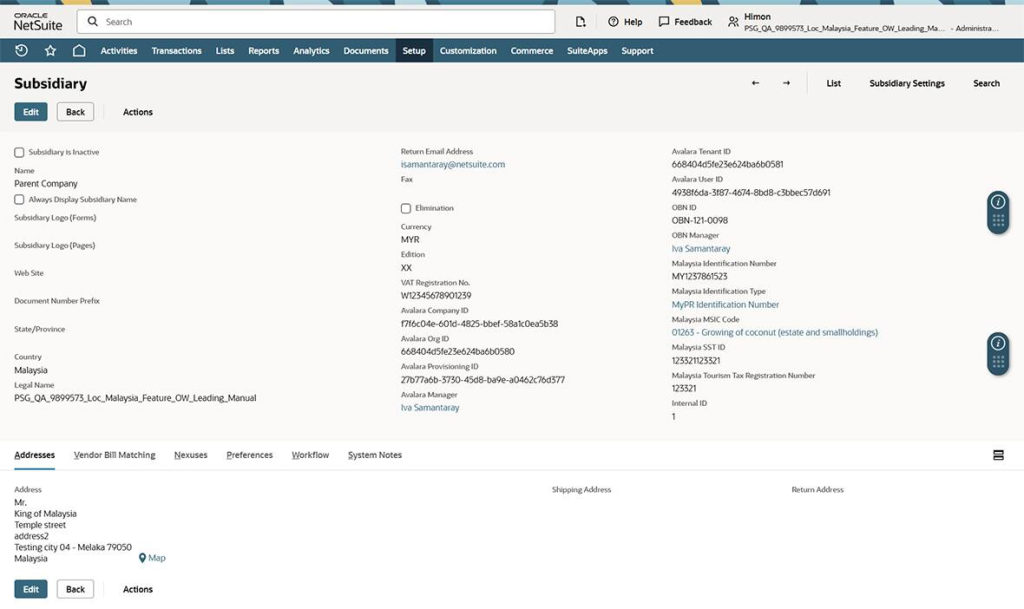
The SuiteApp works with NetSuite’s existing financial and transaction records to prepare structured documents for the UAE’s Peppol-based e-invoicing framework.
For businesses already using NetSuite, the SuiteApp provides a way to process electronic documents within their existing ERP environment. It supports UAE-specific configuration across subsidiary, customer, vendor, transaction, and item records, including legal registration identifiers, invoice classification codes, tax exemption reasons, reverse-charge classifications, and payment information.
Your finance team still needs to ensure that the underlying records contain the information required for electronic exchange. For example, a business running NetSuite OneWorld must maintain the correct tax identifiers, legal details, and invoice classifications for each relevant subsidiary. Missing buyer identifiers, incorrect VAT categories, or incomplete payment information affect the electronic document generated from those transactions.
The SuiteApp also provides e-document status and audit trail functionality for monitoring processing activities. However, the business must configure the supported service provider connection, complete the necessary onboarding, and verify that its actual invoice scenarios are covered. The native functionality should be assessed against existing custom fields, SuiteScript logic, approval processes, and any requirements that fall outside the standard setup.
Best suited for: NetSuite businesses looking to implement the available UAE electronic invoicing functionality within their ERP, particularly where supported transaction types and standard configurations meet their requirements.
2. Folio3 NetSuite UAE E-Invoicing Services
Folio3 provides end-to-end NetSuite e-invoicing implementation and integration services for UAE businesses, including an ASP-agnostic connection approach that works with the accredited provider selected by the customer. Its services cover NetSuite readiness assessments, PINT AE data mapping, electronic invoice processing, integration testing, and ongoing operational support.
Unlike an e-invoicing platform tied to a particular exchange provider, Folio3’s approach focuses on connecting the business’s existing NetSuite environment with its preferred ASP. If your business has already appointed an accredited provider, the implementation can be planned around that relationship rather than requiring you to change providers solely to establish NetSuite connectivity.
NetSuite E-Invoicing Capabilities that Improve Your Financial Operations
Folio3’s UAE NetSuite e-invoicing services cover the following integration and operational requirements:
- PINT AE validation and outbound invoicing: Configure the processing of approved NetSuite invoices and credit notes, map the required electronic document fields, and identify missing or invalid information before transmission.
- Incoming supplier invoices: Integrate inbound electronic invoices with NetSuite accounts payable processes, including vendor bill processing and the applicable purchasing controls.
- Transaction status and exception handling: Return ASP processing responses to NetSuite, identify rejected invoices, and support corrections and controlled resubmission.
- NetSuite OneWorld configuration: Apply UAE-specific invoicing requirements to relevant subsidiaries, including legal identifiers, tax classifications, and applicable VAT Tax Group exclusions.
- ASP-agnostic connectivity: Develop and configure the connection to the customer’s selected UAE-accredited service provider without requiring a specific proprietary exchange network.
- Audit records and monitoring: Maintain electronic document records, processing outcomes, and associated transaction information for operational monitoring and audit purposes.
The implementation route depends on your existing NetSuite configuration and ASP requirements. Folio3 supports both native SuiteApp configuration and connector development, with the specific integration functions established during the readiness and implementation assessment.
For businesses operating across several jurisdictions, Folio3 also brings experience implementing e-invoicing solutions in Saudi Arabia, Zambia, Poland, and France, in addition to the UAE. Having worked with these different electronic invoicing frameworks, its team understands the practical requirements involved in invoice-data mapping, tax classifications, electronic exchange, and testing across multiple regulatory environments.
The service also extends into post-go-live operations. Folio3 supports businesses with transaction monitoring, rejection resolution, integration maintenance, regulatory specification updates, and onboarding additional subsidiaries. This is particularly relevant if your NetSuite account contains custom transaction processes or your business expects its electronic invoicing requirements to change as operations expand.
Best suited for: NetSuite businesses that have already selected an ASP, use customized invoicing processes, operate multiple UAE subsidiaries, or need integrated AR and AP processing with ongoing technical support.
3. Azdan E-Invoice for NetSuite
Azdan provides a dedicated UAE e-invoicing application for NetSuite along with an accredited service provider platform. Azdan Business Analytics is designed to create and process electronic invoices using existing ERP transactions.
The application generates PINT AE XML documents and performs pre-submission checks against mandatory invoice information. Azdan’s product documentation identifies support for extracting invoice details, customer and supplier tax information, VAT amounts, and relevant transaction fields from NetSuite.
For a wholesale distributor, the application processes invoice information that already exists in the ERP, including the customer, subsidiary, item quantities, prices, and tax calculations. The validation process checks the information required for the electronic document before submission, reducing the need for separate invoice preparation outside NetSuite.
Azdan also provides electronic invoice tracking, error handling, and reporting capabilities through its wider platform. Finance users can create and approve invoices in NetSuite, follow delivery and reporting results in Azdan, and return to NetSuite to complete the necessary checks.
Businesses should establish the precise functionality of the dedicated application, particularly for incoming supplier invoices and the synchronization of status information.
Suitable for: UAE businesses looking for a dedicated NetSuite e-invoicing application from an accredited service provider.
4. Complyance E-Invoicing
Complyance offers a multi-country e-invoicing platform with an advertised SuiteApp-based connector for Oracle NetSuite.
Its published connector capabilities include retrieving invoice information from NetSuite, submitting documents through the Complyance platform, and updating ERP records with the resulting compliance statuses.
For finance teams, status synchronization is a significant differentiator. A business processing hundreds of customer invoices through NetSuite needs to distinguish documents awaiting submission from those that have failed validation or completed the relevant exchange and reporting stages. When those statuses are associated with NetSuite transaction records, employees have a clearer basis for investigating unresolved invoices.
Complyance also supports API connectivity, webhooks, automated and batch submission, and international document requirements. Businesses using NetSuite OneWorld across multiple countries can manage electronic invoicing through Complyance’s platform, with country-specific configurations for document formats, tax requirements, and reporting obligations..
Suitable for: NetSuite businesses seeking a prebuilt connector with multi-country compliance and transaction status synchronization.
5. ClearTax UAE E-Invoicing
ClearTax provides tax compliance and electronic invoicing services with configurable ERP integrations.
ClearTax supports Oracle NetSuite integration through REST APIs and middleware. Rather than requiring finance teams to recreate invoices in a separate application, its integration approach transfers transaction information from the ERP to the compliance platform, where the data is mapped, validated, and processed for the applicable electronic invoice requirements.
Consider a professional services company that creates invoices in NetSuite using project milestones and contract billing information. The source transaction includes the accounting amounts and customer details, while the e-invoicing integration must extract the information required by the UAE specification. If a buyer identifier or tax classification is missing, the integration needs to identify the source of the discrepancy so the finance team can correct the relevant record.
ClearTax provides several connectivity methods across its platform, including APIs, middleware, secure file exchange, and bulk submission. These options are relevant to businesses with existing integration infrastructure or highly customized billing processes.
Its wider product portfolio also includes accounts payable processing. Companies should determine which inbound capabilities are part of the proposed NetSuite implementation, since enterprise platform functionality and the actual ERP integration scope are separate considerations.
Suitable for: NetSuite businesses seeking configurable tax compliance integration through existing APIs or middleware.
6. Flick Network
Flick Network provides an accredited UAE electronic invoicing service with published Oracle NetSuite integration support and detailed developer documentation.
Its integration offering identifies NetSuite alongside Oracle Fusion Cloud ERP and Oracle E-Business Suite. Flick also documents the technical process for submitting invoices, validating document information, and retrieving exchange and reporting results.
Flick processes invoices in stages, so an accepted submission doesn’t mean the invoice has reached the buyer. For example, when you receive an HTTP 202 response, Flick has accepted your invoice for processing, but delivery to the buyer and reporting to the FTA are still pending. Your NetSuite integration needs to track these subsequent stages before marking the invoice as successfully processed.
For a NetSuite implementation, this distinction affects the status information stored against customer invoices. If the integration treats an accepted API request as a completed transmission, the finance team could incorrectly assume that the invoice has passed every required stage. The process needs to retain the electronic document identifier and track the relevant subsequent responses.
Make sure your confirm whether NetSuite connectivity is delivered through an existing connector or a configured API integration, as well as which statuses are returned to the ERP.
Suitable for: Businesses seeking a documented API integration and clear separation of electronic invoice processing stages.
6. EDICOM Global E-Invoicing
EDICOM provides international e-invoicing and electronic data interchange services for businesses that exchange financial and commercial documents across multiple systems.
The platform turns ERP transaction data into the formats required by the receiving network or local regulatory system, validates the documents, and manages their electronic exchange. EDICOM’s UAE service addresses the Peppol-based model and the country’s electronic invoice reporting requirements.
Its electronic data interchange services are especially relevant to manufacturers and distributors that already exchange purchase orders, shipping information, and invoices with customers and suppliers.
The company supports integration with leading enterprise systems, including NetSuite, but businesses should verify the exact UAE NetSuite connection method and identify where document transformation and validation occur. They should also examine how exchange results and tax-reporting confirmations return to their financial records.
Suitable for: Manufacturers, wholesalers, and multinational businesses with international invoicing and EDI requirements.
7. Comarch E-Invoicing
Comarch provides an enterprise electronic invoicing platform supporting international document exchange, accounts receivable, accounts payable, and integration with existing ERP systems.
Its published platform information explicitly includes NetSuite among the supported ERP systems. The solution provides document transformation, multi-level validation, electronic transmission, monitoring, and archiving, with support for Peppol connectivity.
Comarch is best-suited to companies that manage invoicing obligations across multiple countries and want a common electronic document exchange platform. A business using NetSuite OneWorld to manage operations across the UAE and Europe must process transactions in accordance with the regulatory and tax requirements of each legal entity. The company must preserve the correct subsidiary information, document classifications, and tax treatment while coordinating reporting across its financial environment.
Comarch’s accounts payable services also address incoming documents from suppliers, including document standardization and invoice registration. Its wider EDI capabilities support electronic communication with trading partners, making the platform relevant where procurement and invoicing are already closely integrated.
Buyers should request confirmation of the NetSuite connector or integration method, the supported PINT AE document types, and the reporting information available inside NetSuite. The provider’s global coverage should be assessed against the countries and transactions required by the business rather than treated as one universal compliance configuration.
Suitable for: NetSuite OneWorld customers and enterprises managing invoicing, procurement documents, and compliance across several jurisdictions.
8. ONESOURCE Pagero E-Invoicing
ONESOURCE Pagero, part of Thomson Reuters, provides an international electronic invoicing network and compliance services.
The platform connects existing financial systems with electronic document exchange networks and the applicable requirements of individual countries. Its offering extends across accounts receivable and accounts payable, addressing both outbound invoice transmission and the receipt of supplier documents.
For NetSuite businesses, this arrangement is relevant where incoming supplier invoices are a significant operational requirement. A distributor receiving large volumes of invoices needs to identify the supplier, detect duplicates, associate documents with purchase orders or receipts, and complete the appropriate approval process before payment.
The electronic invoice provides structured data, but that data still needs to enter the correct NetSuite records and pass the company’s established AP controls. Buyers should identify whether the proposed connection is delivered directly through Pagero, through SpendConsole, or through another integration component, and establish where invoice matching and exception handling take place.
Suitable for: Large enterprises with international e-invoicing obligations and substantial supplier invoice processing requirements.
How Does UAE E-Invoicing Integration Work in NetSuite?
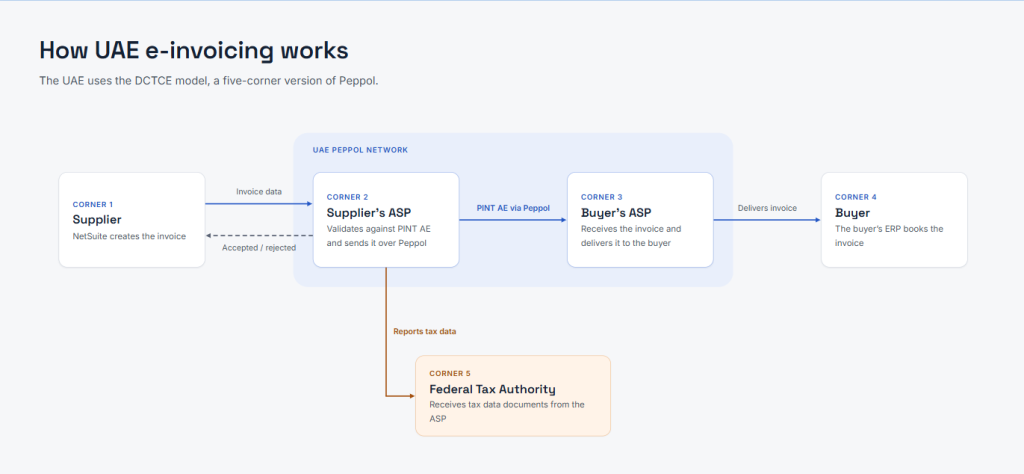
UAE e-invoicing connects NetSuite’s financial transactions with an accredited service provider that validates, exchanges, and reports structured electronic invoices under the country’s Peppol-based five-corner model.
NetSuite holds the underlying customer, supplier, subsidiary, and accounting information. The integration transfers the required data to the ASP, while the ASP performs the regulated exchange and tax-reporting services. Each system therefore has a distinct responsibility.
From NetSuite Invoice to Electronic Exchange
Consider a UAE distributor using NetSuite to issue a customer invoice for AED 50,000, excluding applicable VAT.
The invoice contains the customer, issuing subsidiary, transaction currency, item details, quantities, prices, and tax information. Once the transaction reaches the agreed submission stage, the integration obtains the required data and passes it to the ASP.
The provider validates the invoice against PINT AE requirements and prepares or processes the structured XML document. The supplier’s ASP exchanges the invoice with the buyer’s ASP and sends the prescribed Tax Data Document to the Federal Tax Authority. The receiving provider completes the relevant validation, delivery, and reporting activities.
The important integration requirement is tracking the result of each stage. Submission to the ASP, technical validation, successful exchange, and tax reporting are separate events. NetSuite should retain the information required to identify the electronic document and reconcile its processing history with the original transaction.
What UAE E-Invoicing Requirements Apply to NetSuite Users in 2027?
The UAE’s electronic invoicing framework requires covered businesses to issue and receive structured electronic documents and use accredited service providers for the prescribed exchange and reporting activities.
The system is based on Peppol interoperability and the UAE-specific PINT AE standard. A PDF or scanned invoice does not satisfy the structured electronic invoice requirement on its own.
UAE E-Invoicing Implementation Deadlines
| Business category | Deadline to appoint ASP | Mandatory implementation |
|---|---|---|
| Annual revenue of AED 50 million or more | October 30, 2026 | January 1, 2027 |
| Annual revenue below AED 50 million | March 31, 2027 | July 1, 2027 |
| Government entities | March 31, 2027 | October 1, 2027 |
The large-business ASP appointment deadline was extended through Ministerial Decision No. 66 of 2026. Businesses should use the amended deadline rather than the original July 2026 date.
The framework applies to covered B2B and B2G business transactions, subject to specific exclusions. Business-to-consumer transactions remain outside the current mandatory scope, although businesses receiving in-scope supplier invoices also need to assess their receiving obligations.
Ministerial Decision No. 197 of 2026 introduced a temporary exclusion for transactions between members of the same VAT Tax Group for 24 months beginning January 1, 2027. It also removed the requirement that electronic invoice data be stored physically in the UAE, while retaining applicable record-retention obligations.
The current legal framework and guidance are available through the UAE Ministry of Finance e-invoicing portal.
What Is PINT AE and Why Does It Matter?
PINT AE is the UAE-specific electronic invoice specification under the Peppol International framework. It defines the information that electronic invoice documents must contain and the validation rules those documents must satisfy.
For a NetSuite user, this means the data stored in ordinary transaction fields must be mapped to the correct electronic document elements. The invoice must include the required business and tax information in a structured format, while conditional requirements depend on the relevant transaction.
The technical specification also contains validation rules addressing tax categories, document identifiers, VAT calculations, and other business conditions. For example, PINT AE version 1.0.4 includes validation corrections related to standard-rated VAT consistency, reverse-charge treatment, and invoices containing multiple VAT categories.
These details are important when selecting an e-invoicing solution because a document with valid XML syntax could still fail the UAE’s business-rule validation.
What Should You Look for in a NetSuite E-Invoicing Solution?
A NetSuite e-invoicing solution should support the business’s actual invoice scenarios, provide a reliable connection to an accredited ASP, and preserve the information needed for financial reconciliation and audit review.
The most important assessment is whether the proposed integration handles both successful transactions and exceptions without creating inconsistencies between NetSuite and the electronic invoicing service.
| Capability | What NetSuite businesses should verify |
|---|---|
| UAE compliance | PINT AE document requirements and the applicable ASP accreditation |
| Customer invoices | Submission of supported NetSuite AR invoices |
| Credit notes | Correct electronic credit-note treatment and original invoice references |
| Incoming invoices | Receipt and processing of structured supplier documents |
| Legal entity management | Correct subsidiary, tax registration, and participant identifiers |
| Tax classification | Mapping for applicable VAT rates, exemptions, and special treatments |
| Currency handling | Appropriate foreign-currency and AED tax information |
| Document validation | Identification of missing fields, incorrect amounts, and invalid classifications |
| Status tracking | Separate exchange, rejection, and tax-reporting outcomes where supported |
| Error correction | Traceable corrections, controlled retries, and duplicate prevention |
| Record retention | Access to structured documents and associated processing evidence |
| Implementation support | NetSuite testing, exception resolution, and ongoing integration maintenance |
Why Incoming Vendor Invoices Are Important
Many e-invoicing providers emphasize outbound invoice generation because transmitting customer invoices is an immediate compliance requirement. For NetSuite finance teams, the receiving process deserves the same level of technical assessment.
When a structured invoice arrives from a supplier, the system must establish which vendor issued it and whether it belongs to an existing purchase order or receipt. If the invoice is valid for processing, the required information should reach the appropriate accounts payable records without bypassing the company’s accounting and approval controls.
For example, a business receiving an invoice for goods that have not been fully received needs to retain the discrepancy for review. Successful receipt through Peppol establishes that an electronic document has arrived, but it does not establish that the supplier’s commercial claim is ready for payment.
Why Validation and Error Handling Are Important in e-invoicing?
A common implementation problem occurs when invoice information is complete for accounting purposes but insufficient for electronic exchange.
A customer invoice might contain an amount, VAT calculation, and legal name while lacking the buyer’s required electronic address. Another invoice might use a NetSuite tax code that does not map correctly to a PINT AE category.
The solution needs to identify these problems at the appropriate stage and provide enough detail for the finance or technical team to resolve them. After correction, the integration should preserve the connection to the original transaction and prevent duplicate electronic submissions.
Error handling should be assessed during provider demonstrations rather than left until production testing.
How Do You Implement UAE E-Invoicing in NetSuite?
Implementing UAE e-invoicing in NetSuite requires an assessment of the existing financial environment, accurate mapping of transaction fields, configuration of the accredited service provider connection, and end-to-end validation before go-live.
The objective is to make electronic invoice processing part of the company’s established transaction controls while satisfying the UAE’s prescribed technical requirements.
Assess NetSuite Transactions and Entities
The first stage establishes which subsidiaries, customer transactions, and supplier transactions fall within the UAE e-invoicing requirements. In a NetSuite OneWorld environment, this assessment must distinguish legal entities, tax registrations, and transaction types rather than treating every invoice as belonging to one company.
The review should include customer invoices, credit memos, vendor bills, relevant self-billing arrangements, exports, and other applicable scenarios. It should also examine custom fields, scripts, and approval processes that determine when an invoice is created or becomes ready for transmission.
The result is a defined implementation scope showing which transactions require electronic processing, which exclusions apply, and where the necessary information originates.
Map NetSuite Fields to PINT AE
The next stage compares the information available in NetSuite with the UAE’s mandatory and conditional electronic invoice requirements.
Customer and vendor identifiers, subsidiary legal details, tax classifications, invoice amounts, transaction currency, and line-level information need to be matched with the applicable PINT AE elements. Where a required value is missing, the team must determine whether it belongs in an existing NetSuite field, a custom field, or another controlled source.
The mapping should also document how different tax codes and transaction classifications are translated into the electronic invoice. This is essential when one NetSuite account serves several business units or contains customizations introduced over multiple years.
Configure the ASP Connection and Status Processing
After mapping is approved, the integration connects NetSuite with the chosen accredited service provider through the agreed SuiteApp, API, or middleware method.
The configuration determines which transactions are submitted, how document identifiers are retained, and how validation errors and exchange responses are processed. It should establish controls that prevent the same invoice from being submitted repeatedly after a failed request or connection interruption.
Finance users also need an agreed way to identify invoices requiring attention. An accepted submission, successful network delivery, and completed tax reporting should be distinguished according to the statuses actually provided by the ASP.
Validate Before Production Go-Live
Testing needs to reproduce real NetSuite transactions, including successful invoices and the exceptions that could disrupt processing after deployment.
The test scope should include different subsidiaries, foreign-currency invoices, mixed VAT categories, credit notes, missing identifiers, rejected documents, and incoming vendor invoices. If existing SuiteScript logic changes transaction values or approval statuses, the test cases should confirm that those customizations do not interfere with electronic document generation.
Both finance and technical teams should review the results. The implementation is ready when the agreed document scenarios have passed, unresolved exceptions have been addressed, and users understand how to investigate failures and reconcile electronic document statuses with NetSuite transactions.
Which E-Invoicing Solution Is Right for Your NetSuite Business?
The right option depends on whether the primary requirement is NetSuite implementation support, a dedicated application from an accredited service provider, or an enterprise e-invoicing platform covering multiple jurisdictions and business systems.
| Business requirement | Options to evaluate | Selection priority |
|---|---|---|
| Existing NetSuite account with customizations | Folio3 integration services with an accredited ASP | Transaction mapping, custom logic, and implementation ownership |
| Dedicated NetSuite e-invoicing application | Azdan, Complyance | Connector coverage and status processing |
| API-based compliance integration | ClearTax, Flick | Technical interfaces and exception handling |
| Multi-country electronic invoicing | Complyance, ClearTax, EDICOM, Comarch | Jurisdiction support and integration requirements |
| Electronic invoicing with EDI | EDICOM, Comarch | Purchase orders, dispatch documents, and invoice exchange |
| International AP and supplier processing | ONESOURCE Pagero | Inbound document processing and enterprise integration |
A NetSuite business with standard billing processes should establish whether an available connector supports its required transactions. A company with custom invoicing, multiple billing applications, or complicated tax classification rules needs to examine how those requirements affect the integration.
The accredited provider’s capabilities and the NetSuite implementation responsibilities should be assessed together. This establishes who manages document validation, who corrects ERP data issues, and who maintains the connection when technical specifications change.
Prepare Your NetSuite Account for UAE E-Invoicing in 2027
The right UAE e-invoicing solution depends on your existing NetSuite configuration, transaction volumes, subsidiary structure, and accredited service provider requirements. Before choosing a platform, evaluate its integration method, supported PINT AE documents, inbound invoice processing, and ability to return exchange and reporting statuses to your financial records.
If your business needs to connect NetSuite with an ASP it has already appointed, Folio3’s NetSuite UAE e-invoicing services cover the required ERP configuration, integration development, testing, and ongoing operational support. You can also complete Folio3’s 12-question readiness assessment to identify gaps in your NetSuite data, ASP onboarding, and electronic invoicing preparation ahead of the 2027 mandate.
Get in touch today with our NetSuite experts.
FAQs
Does NetSuite Support UAE E-Invoicing in 2027?
NetSuite provides electronic document capabilities, including UAE-specific localization functionality. A compliant implementation still requires the applicable configuration, supported invoice formats, an accredited service provider arrangement, and validation of the actual transaction scenarios in the company’s account.
Does a NetSuite Business Need an Accredited Service Provider?
Yes. Businesses within the UAE’s mandatory e-invoicing scope need an accredited service provider for regulated electronic invoice exchange and tax-data reporting. A NetSuite implementation partner manages the relevant ERP integration and configuration activities, while the accredited provider performs the prescribed exchange and reporting services.
Can UAE E-Invoicing Work With NetSuite OneWorld?
Yes. NetSuite OneWorld businesses need to configure the relevant legal entities, subsidiary tax details, transaction classifications, and electronic participant identifiers. The integration must ensure that invoices are exchanged and reported under the correct entity and that the selected provider supports the required multi-subsidiary setup.
What Happens When a UAE E-Invoice Is Rejected?
The required response depends on the stage at which the document fails. An invoice rejected during validation needs the identified data or classification issue corrected before controlled resubmission. Exchange and reporting failures require separate investigation. The integration should preserve the original transaction reference, processing history, and subsequent outcome.
Is a PDF Invoice Acceptable Under UAE E-Invoicing?
No. A PDF by itself does not satisfy the UAE’s electronic invoice format requirements. Covered transactions must be exchanged as structured electronic documents using the applicable specification and accredited provider process. A human-readable representation remains useful for review, but it does not replace the required structured document.
