
Key Takeaways
- Composable commerce uses specialized applications for specific functions. Fashion brands use separate tools for ecommerce, content, search, personalization, checkout, and other customer-facing experiences.
- NetSuite brings financials, inventory, purchasing, order management, customer data, reporting, and other business processes into one platform.
- NetSuite fits both commerce models. You can connect specialized ecommerce platforms to NetSuite while keeping inventory, orders, purchasing, fulfillment, and financials within the ERP.
- Fashion brands benefit from separating customer experience from business operations. Ecommerce platforms manage shopping experiences while NetSuite manages the operational data and transactions behind them.
- The right setup depends on business requirements. Sales channels, product complexity, inventory structure, wholesale operations, customer experience requirements, and internal technology resources should guide the decision
Global fashion ecommerce revenue is projected to reach $957.31 billion in 2026, according to Shopify’s 2026 fashion ecommerce report. Fashion brands continue to expand across ecommerce, marketplaces, wholesale, social commerce, and other digital channels, creating more product, inventory, order, fulfillment, and financial data to manage.
Fashion technology decisions now demand that brands decide how customer-facing commerce tools connect with the systems that manage products, inventory, orders, purchasing, fulfillment, and financials.
Two approaches stand out. One is that of composable commerce, and the other one is that of an all-in-one ERP model.
Composable commerce separates ecommerce functions across specialized platforms. A business might use Shopify Hydrogen or BigCommerce for the storefront, Algolia or Constructor for search, Bloomreach or Dynamic Yield for promotions and personalization, Stripe or Adyen for payments, and NetSuite for order management, inventory, and ERP, with integrations connecting these systems
An all-in-one ERP commerce model keeps core ecommerce and business operations within the same technology environment. The storefront, customer accounts, orders, inventory, pricing, and financial data connect directly to the ERP rather than relying on a collection of separate commerce applications.
For brands using NetSuite, these approaches work together. NetSuite manages core business operations while specialized commerce platforms manage the customer-facing shopping experience.
What Is Composable Commerce?
Composable commerce is a technology approach that combines specialized applications into one ecommerce setup. Instead of relying on one platform for every commerce function, a business selects separate tools for ecommerce, content management, search, personalization, checkout, payments, and other customer-facing requirements.
A composable setup separates the customer experience from the systems that manage business operations. A fashion brand could use a headless storefront, a specialized CMS, a search platform, a personalization engine, and NetSuite while connecting these systems through APIs and integration workflows.
For example, you could change the search platform without replacing the ecommerce storefront. You could introduce a new customer experience while keeping NetSuite as the ERP. You could also connect different commerce channels to the same product and inventory data.
MACH architecture in Composable Commerce
MACH architecture is the technical foundation behind most composable commerce setups. MACH stands for Microservices, API-first, Cloud-native, and Headless. Microservices allow individual commerce functions to be updated independently, API-first design lets systems communicate through well-defined interfaces, cloud-native applications scale as demand changes, and headless architecture separates the frontend customer experience from backend commerce logic.
NetSuite commonly acts as the operational backbone in a composable commerce architecture. It can manage products, pricing, inventory, customers, orders, invoicing, tax, fulfillment, and financial reporting while specialized commerce tools manage the customer-facing experience. APIs, middleware, and integration workflows keep product data, inventory levels, orders, refunds, and customer records synchronized between NetSuite and the commerce tools.
Composable commerce gives businesses flexibility, faster innovation, channel independence, and the ability to adopt best-of-breed tools. It works best when businesses maintain strong integration governance, clear data ownership, API standards, error handling, testing, and monitoring so inventory, pricing, orders, and customer data stay consistent across systems
What Is an All-in-One ERP Approach?
An all-in-one ERP approach places multiple core business functions within one enterprise platform. NetSuite brings financial management, inventory, purchasing, order management, CRM, reporting, and other operational processes into one system.
It’s safe to say that the ERP becomes the central system for business data and transactions.
For an apparel business, this structure connects product and inventory information with purchasing, sales, fulfillment, financial reporting, and other operational processes. Your teams get to work from the same underlying records instead of maintaining separate operational databases for each function.
The all-in-one approach reduces the number of systems required for core business management. Like a cherry on top, it also provides a common data model across departments.
Composable Commerce vs. All-in-One ERP: What Is the Difference?
Composable commerce separates customer-facing functions across specialized applications, while an all-in-one ERP brings core operational functions into one platform.
| Area | Composable Commerce | All-in-One ERP |
|---|---|---|
| Ecommerce storefront | A dedicated ecommerce platform manages the online shopping experience. | The ERP manages core business operations while the ecommerce experience runs within the platform or a connected commerce system. |
| Content management | A dedicated CMS manages website content, landing pages, editorial content, and merchandising experiences. | Content management uses the ERP’s available capabilities or a connected CMS. |
| Product search | A specialized search platform manages search, filtering, and product discovery. | Search uses the commerce or ERP capabilities available within the ERP. The ERP maintains centralized inventory records across business locations and transactions. The ERP manages sales orders alongside inventory, fulfillment, customers, and financial transactions |
| Inventory management | An ERP or inventory system manages stock while commerce applications display availability. | |
| Order management | Ecommerce applications capture orders and send transaction data to the ERP or order management system. | |
| Financial management | A separate ERP manages accounting, payments, receivables, payables, and financial reporting. | Accounting, financial reporting, receivables, payables, and related business records operate within the ERP. |
| Customer experience | Specialized tools manage storefronts, personalization, search, content, checkout, and other customer-facing functions. | The platform provides a more consolidated set of commerce and business-management functions. |
| Technology setup | Multiple specialized applications connect through integrations and APIs. | Fewer core systems handle a larger share of business operations. |
| Data management | Data is distributed across specialized applications, with integrations connecting the relevant records. | Core business data is maintained within a central ERP system. |
| Customization | Individual commerce components can be selected or replaced according to specific requirements. | Configuration and customization happen within a central business platform. |
Neither model fits every fashion brand. The right choice for your business depends on the brand’s sales channels, product complexity, customer experience requirements, internal technology resources, and operational processes.
Why Does Composable Commerce Matter for Brands?
Composable commerce gives brands flexibility across customer-facing experiences. Fashion ecommerce requires more than product listings and checkout. Brands manage large catalogs, seasonal collections, product variants, content, promotions, regional storefronts, wholesale channels, and customer experiences.
This setup suits brands that want to evolve individual parts of their digital experience without replacing the entire technology stack.
If your business deals with frequent assortment changes such as new styles, colors, sizes, prices, and product content, then a specialized commerce setup gives digital teams more control over how those products appear and behave online.
Why Does an All-in-One ERP Matter for Fashion Operations?
An ERP provides the operational structure behind commerce activities. Fashion brands need accurate inventory, purchasing, order processing, fulfillment, financial management, and reporting across channels. NetSuite brings these functions into one business system.
For example, a wholesale order affects inventory and revenue. An ecommerce order affects inventory and fulfillment. A purchase order affects inventory planning and accounts payable. A return affects inventory and financial records.
When these transactions operate within the same ERP environment, teams get a consistent view of the underlying business activity.
This becomes especially important for brands with multiple warehouses, subsidiaries, sales channels, or currencies. The ERP gives finance and operations teams a common source for business transactions.
How Does NetSuite Fit Into a Composable Commerce Setup?
Native integrations and connectors provide a direct route for connecting specific commerce platforms with NetSuite. They are useful when a prebuilt connector supports the required data flows, such as product information, customer records, sales orders, inventory availability, fulfillment updates, and refunds. For example, Folio3’s NetSuite connectors for ecommerce platforms support data exchange between NetSuite and the connected commerce system, reducing the need to build every integration from scratch.
iPaaS platforms provide another option when your composable commerce setup involves multiple applications or more complex data flows. Solutions such as Dell Boomi, MuleSoft, and Oracle Integration Cloud (OIC) connect NetSuite with ecommerce platforms, order management systems, payment applications, marketplaces, and other business systems through APIs, connectors, and integration workflows.
- Boomi provides connectors and integration workflows for exchanging data between NetSuite and connected applications. It supports integration scenarios involving commerce, customer data, orders, inventory, and fulfillment.
- MuleSoft uses APIs and integration flows to connect NetSuite with commerce platforms and other enterprise applications. It is relevant when teams need to coordinate data across multiple systems and manage reusable API integrations.
- Oracle Integration Cloud (OIC) offers NetSuite connectivity through its integration capabilities and Oracle application ecosystem. It supports integrations between NetSuite and connected applications, including workflows for synchronizing business data.
The key consideration is how each integration handles the specific data flows your commerce operations require. Product and inventory synchronization, order creation, fulfillment updates, customer records, pricing, and financial transactions need clearly defined mappings, error handling, and synchronization rules. Some flows require near-real-time updates, while others can run on a schedule.
For a composable commerce setup with several independent platforms, map these data exchanges before selecting the integration method. A native connector may cover a straightforward platform-to-NetSuite connection, while an iPaaS solution may be more suitable when the implementation involves several applications, complex transformations, or coordinated workflows. The goal is to keep commerce systems synchronized with NetSuite without creating unnecessary integration complexity
Which Fashion Operations Should NetSuite Manage?
NetSuite manages the business processes behind ecommerce and wholesale transactions. These processes include financials, inventory, purchasing, order management, fulfillment, customer records, and reporting.
Product and SKU Management
Fashion brands need structured product data across styles, colors, sizes, and individual SKUs.
A style-color-size structure gives each variant its own inventory identity while keeping it connected to the parent style. NetSuite supports this product structure through matrix items.
You can use the ERP as the source for product and SKU information while sending the required data to ecommerce and wholesale systems.
This approach also keeps product relationships consistent when the same style appears across multiple sales channels.
Inventory Management
Inventory becomes difficult to manage when fashion brands sell through several channels and locations.
NetSuite provides centralized inventory records across locations and transactions. Ecommerce platforms then receive the inventory information required for online sales.
You can connect inventory across DTC, wholesale, marketplaces, and other sales channels through defined integration workflows.
For example, a sale through an ecommerce store reduces available inventory in the ERP. That updated inventory position then feeds the relevant sales channels according to the integration rules.
Order Management
Orders from ecommerce and wholesale channels need to reach the operational system that manages fulfillment and financial processing.
NetSuite provides sales order management and connects order processing with inventory and fulfillment.
This gives operations teams a common transaction record regardless of the channel where the order originated.
You can also establish different order workflows for DTC, wholesale, marketplace, and retail transactions while keeping the resulting business records within NetSuite.
Purchasing and Supply Chain
Fashion brands purchase finished products, raw materials, packaging, and other inventory required for production and sales.
NetSuite connects purchasing activity with inventory and financial operations. Buyers gain visibility into purchase orders, receipts, vendor information, and inventory requirements.
You can also connect demand and sales information to purchasing decisions through reporting and planning workflows.
This gives purchasing teams a clearer view of what has been ordered, what has been received, and what inventory remains available.
Financial Management
NetSuite connects sales, refunds, payments, inventory, purchasing, accounts receivable, accounts payable, and financial reporting within the ERP.
This gives finance teams access to commerce-related transactions without relying on separate spreadsheets for every sales channel.
A connected setup also gives finance teams a clearer relationship between sales activity and the underlying financial records.
How Does NetSuite Work With Ecommerce Platforms?
NetSuite works with ecommerce platforms through integration workflows that synchronize the data required by both systems.
The ecommerce platform handles the customer-facing experience. NetSuite manages the underlying operational and financial transactions.
Common synchronization areas include:
- Products and SKUs
- Product variants
- Prices
- Customers
- Sales orders
- Inventory
- Fulfillment
- Shipping information
- Returns
- Refunds
- Payment information
The exact data flow depends on the commerce platform and business requirements.
You should define the system of record for each data type before building the integration. For example, NetSuite could serve as the source for inventory and financial data while the ecommerce platform controls storefront content and merchandising presentation.
This distinction prevents multiple systems from competing to update the same business record.
How Does This Setup Support Omnichannel Fashion Retail?
Fashion brands frequently operate across DTC ecommerce, wholesale, marketplaces, retail stores, and regional websites.
A NetSuite-centered setup gives these channels access to shared business data while allowing each channel to use its own customer-facing technology.
For example, a fashion brand could operate:
- Shopify for DTC ecommerce
- JOOR for wholesale
- Amazon for marketplace sales
- Retail POS for physical stores
- NetSuite for ERP operations
Each channel serves a different commercial purpose. NetSuite connects the underlying inventory, order, customer, purchasing, and financial processes.
This setup also supports consolidated reporting across channels.
You can review sales across DTC, wholesale, marketplaces, and retail while keeping the underlying transactions connected to the relevant business records.
What Should Be the Source of Truth in a NetSuite Ecommerce Setup?
The source of truth should depend on the type of data and the business process that owns it. NetSuite frequently serves as the operational source for inventory, transactions, purchasing, and financial records, while the ecommerce platform manages the customer-facing shopping experience.
You should define ownership before building the integration.
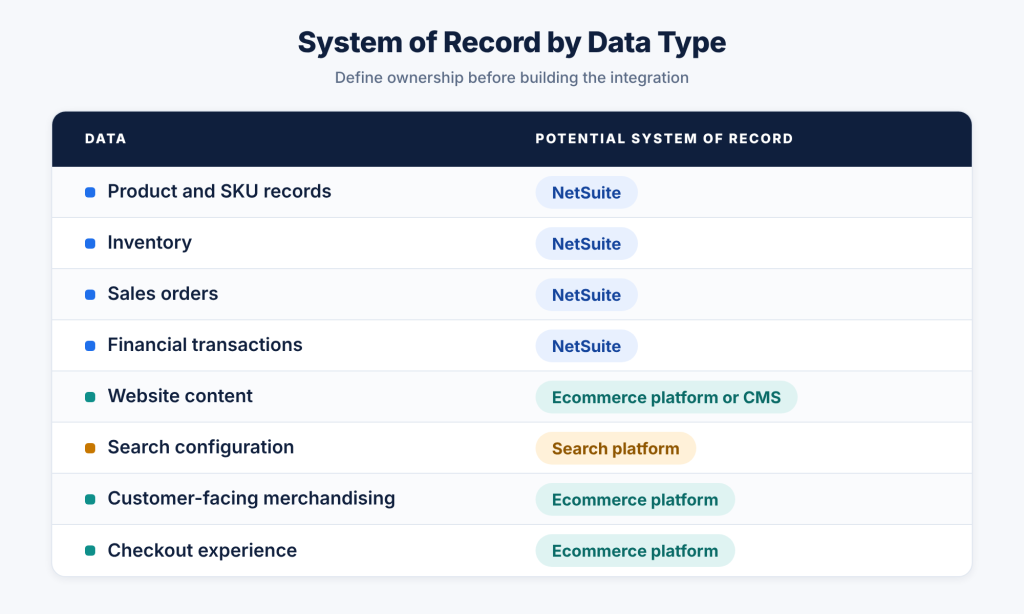
The exact ownership model depends on the business. A fashion brand with complex product operations could use NetSuite for product and inventory records while the ecommerce platform controls website presentation.
The important step is to establish ownership before integration development starts. This prevents two systems from competing to update the same record.
When Should a Fashion Brand Choose Composable Commerce?
Composable commerce fits fashion brands that require specialized customer experiences and a flexible technology setup.
You should choose composable commerce for your business if you have:
- Multiple customer-facing platforms
- Headless or highly customized storefronts
- Specialized search or personalization
- Multiple regional ecommerce experiences
- Separate DTC and B2B experiences
- Frequent changes to digital experiences
- Integration with specialized commerce applications
You should also assess your internal technology capabilities before selecting this model. A composable setup requires integration management across multiple applications.
It is also important to define ownership for each system before implementation. Your ecommerce platform could own the customer-facing product presentation while NetSuite owns inventory, financial, and operational records.
When Does an All-in-One ERP Approach Make More Sense?
An all-in-one ERP approach fits businesses that want centralized management of core operations and fewer systems for business-critical processes.
It makes sense when you need:
- Centralized financial management
- Unified inventory
- Multi-location operations
- Integrated purchasing
- Order management
- Wholesale and ecommerce coordination
- Multi-subsidiary reporting
- Centralized business reporting
NetSuite provides these ERP capabilities while still supporting connections to specialized commerce platforms.
You can keep core operations in one system while adding specialized tools where the business requires them.
Should a Fashion Brand Choose Composable Commerce or NetSuite?
The choice does not have to be either composable commerce or NetSuite. A fashion brand can use NetSuite as its ERP while adopting a composable approach for customer-facing commerce.
This setup separates two requirements:
- Commerce technology manages how customers interact with the brand.
- NetSuite manages how the business operates behind those interactions.
You can select the ecommerce platform that fits your customer experience requirements without replacing the ERP every time your commerce strategy changes.
This model also gives fashion brands room to add sales channels. A new marketplace or wholesale platform can connect to the same NetSuite environment without forcing the business to rebuild its core operational system.
How Should You Build a NetSuite-Centered Commerce Setup?
Our NetSuite consultants recommend that you always start with your business processes.
Map your product, inventory, order, fulfillment, purchasing, financial, wholesale, and ecommerce workflows. Identify which system owns each type of data and define how information moves between platforms.
Then evaluate the integration requirements.
A practical planning process includes:
1. Map Every Sales Channel
Document DTC, wholesale, marketplaces, retail, and regional storefronts. Identify the transactions generated by each channel.
2. Define the System of Record
Decide which platform owns products, inventory, customers, orders, pricing, and financial data.
3. Document Data Flows
Identify which information moves between ecommerce platforms and NetSuite. Define when each synchronization occurs and which system initiates it.
4. Map Product Variants
Ensure every ecommerce SKU connects to the correct NetSuite item. This step is particularly important for apparel brands with style-color-size matrices.
5. Define Inventory Rules
Establish how inventory quantities move between NetSuite and each channel. Define how multiple locations, reserved inventory, and available inventory are handled.
6. Map Order and Fulfillment Workflows
Document the movement from ecommerce order through NetSuite fulfillment and shipment. Include cancellations, partial shipments, returns, and refunds.
7. Plan Exception Handling
Define how failed orders, unmatched SKUs, inventory discrepancies, cancellations, and returns are handled. Assign ownership for resolving integration errors.
8. Test Before Launch
Test the complete transaction lifecycle across each connected system. Test standard orders alongside exceptions so teams know how the integration behaves under real operating conditions.
Build a Commerce Setup That Fits Your Fashion Business
Your ecommerce platform should support the customer experience your brand wants to deliver. Your ERP should support the operational processes that keep products, inventory, orders, fulfillment, and financials connected.
If you are evaluating NetSuite for your fashion brand, start with your existing sales channels, product structure, inventory model, and integration requirements.
FAQs
Is NetSuite an ecommerce platform?
NetSuite is an ERP platform rather than a dedicated ecommerce platform. It manages business processes such as financials, inventory, purchasing, orders, customers, and reporting, while ecommerce platforms manage the customer-facing shopping experience.
Does a fashion brand need composable commerce if it uses NetSuite?
No. NetSuite works with both consolidated and composable commerce setups. A fashion brand with straightforward ecommerce requirements could use a connected ecommerce platform and NetSuite without building a large collection of specialized commerce applications.
Can Shopify and NetSuite work together for fashion ecommerce?
Yes. Shopify and NetSuite work together through integration solutions that synchronize data such as products, SKUs, orders, inventory, fulfillment, and other required records. The integration needs clear rules for data ownership and synchronization.
How does NetSuite handle apparel variants?
NetSuite supports matrix items for products with combinations such as style, color, and size. Each child item represents a specific variant and provides its own inventory identity.
Does composable commerce require multiple integrations?
Yes. A composable setup connects separate applications for functions such as ecommerce, content, search, personalization, checkout, or other customer-facing requirements. Each connection requires defined data flows, field mappings, monitoring, and maintenance.
Is an all-in-one ERP better than composable commerce for fashion?
The two approaches serve different requirements. An all-in-one ERP emphasizes centralized business operations, while composable commerce emphasizes flexibility across specialized customer-facing applications. A fashion brand should evaluate its sales channels, product complexity, customer experience requirements, operational processes, and technology resources before selecting a model.
What happens when an ecommerce order fails to sync with NetSuite?
The integration should identify the failed transaction and provide an error or exception record for investigation. The resolution process depends on the cause, such as an unmatched SKU, missing customer information, invalid field mapping, or another configuration issue.
Should a fashion brand use one ecommerce platform for DTC and wholesale?
Not necessarily. A brand could use one platform for both channels or separate platforms based on the requirements of each customer group. NetSuite provides the ERP layer that connects the resulting orders, inventory, purchasing, fulfillment, and financial records.
Is composable commerce harder to maintain?
A composable setup requires management of multiple applications and their integrations. That adds technical and operational responsibilities compared with a more consolidated technology setup. The trade-off is greater control over individual customer-facing components.
When should a fashion brand consider moving to a more composable setup?
A brand should evaluate composable commerce when its customer-facing requirements extend beyond the capabilities of a single commerce platform. Examples include specialized search, headless experiences, advanced personalization, multiple regional storefronts, separate B2B and DTC experiences, or a need to replace individual commerce components independently.
