Key Takeaways
- Selecting a managed services partner is different from selecting an implementation partner. Implementation is a project with a defined end. Managed services is an ongoing relationship.
- Most businesses evaluate managed services partners the wrong way. They compare feature lists and pricing. The partners who look best on paper are often not the ones who perform best in practice.
- Five questions reveal more than any capabilities document. Ask them specifically. The answers tell you exactly what you are buying.
- The handoff from implementation to managed services is the highest-risk moment. Whether that knowledge transfers correctly determines whether the first 90 days go smoothly or badly.
- Red flags during evaluation matter as much as green flags. Vague SLA language, no industry references, and T&M pricing are all signals worth taking seriously.
- A pilot engagement is the most reliable selection method. It removes the gap between what a partner promises and what they actually deliver.
We have had the same conversation with a lot of NetSuite administrators. They got burned by a managed services partner. The partner looked good in the evaluation: certified, experienced, reasonably priced, positive references. The engagement started well enough. Then the named consultant was replaced by someone who had never seen their system. The monthly calls became status updates. Issues sat in the queue for days. By month eight, they were considering switching again.
When we ask what the evaluation process looked like, the answer is usually the same. They compared a few proposals, checked some certifications, called one reference, and picked the partner with the most relevant case study.
That process filters out obviously bad partners. It does not reliably identify good ones.
This guide covers a better approach: how to structure the selection process, which questions actually reveal partner quality, what red flags to watch for, and why a pilot engagement changes the dynamic in your favor.
Why Selecting a Managed Services Partner Is Different
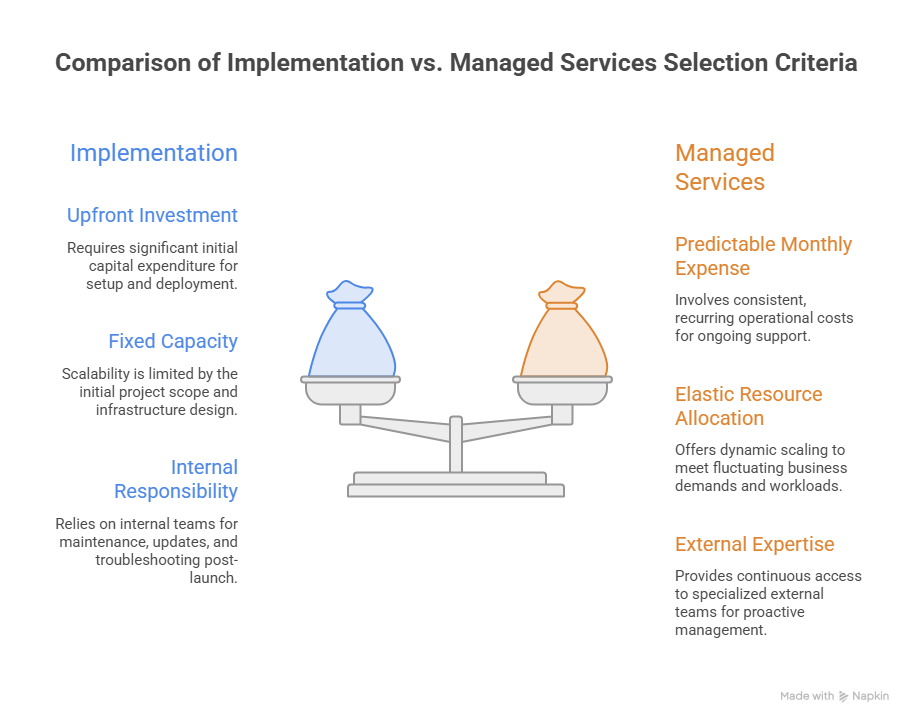
The way businesses select implementation partners does not work for managed services.
| Implementation Partner | Managed Services Partner | |
|---|---|---|
| Engagement type | Project with a defined end | Ongoing relationship, no finish line |
| Primary evaluation criteria | Methodology, project management, go-live track record | SLA consistency, named consultant model, proactive orientation |
| Risk window | During the project | Every day after go-live |
| What you cannot see upfront | Unlikely to matter post-go-live | How they handle emergencies, staff turnover, and release updates |
| Typical contract | Fixed scope and timeline | Rolling monthly or annual |
A managed services partner takes ongoing responsibility for the administration, optimization, and evolution of your NetSuite instance. That covers system configuration, SuiteScript and workflow automation, report building, integration maintenance, user training, and twice-yearly upgrade testing, all under a structured agreement with defined service level commitments.
That scope is broad. Evaluating it requires a different process than comparing implementation proposals.
[VISUAL: Implementation vs. Managed Services Selection Criteria Comparison — two columns showing criteria differences]
Step 1: Define What You Actually Need Before You Talk to Anyone
The most common selection mistake is starting with partner conversations before you know what you need. This puts partners in control of the narrative. They present their capabilities. You evaluate based on what they chose to show you.
Before you contact a single provider, answer these four questions internally:
| Question | What to Avoid | What to Aim For |
|---|---|---|
| What are your current pain points? | “We need better support” | “Our month-end close takes 14 days because three reports are inaccurate and nobody knows why” |
| What does success look like in 12 months? | “Better system performance” | “Automated workflows that currently run manually, close completed in 6 days” |
| What is your internal NetSuite capability? | Leaving this undefined | Know whether you need execution or direction-setting from the partner |
| What is your realistic budget? | Getting surprised mid-evaluation | Know your $3,000-$12,000/month range before conversations begin |
Specific pain points let you evaluate whether a partner has actually solved this before. Vague pain points produce vague proposals.
For context on what drives managed services cost up or down, our guide on NetSuite managed services cost and pricing covers the pricing variables in detail.
Step 2: Build a Shortlist Based on Fit, Not Fame
The NetSuite partner ecosystem includes hundreds of firms. Most are not right for your situation. Shortlisting is about narrowing to partners who are a plausible fit, not the ones with the most impressive website.
Use these three filters:
Filter 1: Industry experience in your specific sector
A provider who has never supported a multi-subsidiary manufacturer will spend your retainer hours learning your business. This applies equally to food distribution, professional services, or SaaS. NetSuite is configured differently in every industry.
When filtering for industry experience, require specifics:
- Not “we have worked with manufacturing clients”
- But “we currently manage 12 mid-market discrete manufacturers on NetSuite, two of which run multi-entity structures similar to yours”
The difference between those two answers is the difference between genuine experience and marketing language.
Filter 2: The named consultant model
A named consultant knows your system, your customizations, and your business logic. A pooled support queue means whoever picks up your ticket that day reads your case notes from scratch.
Before any partner makes your shortlist, confirm:
- How account assignments work
- How long a typical consultant stays on a single account
- What the handover process looks like when a consultant changes
Filter 3: Oracle certification and partner tier
Oracle NetSuite designates Solution Providers and Alliance Partners by tier. Tier signals investment in NetSuite expertise, but is not a sufficient criterion on its own. A high-tier partner with no experience in your industry is still the wrong choice.
Use tier as a minimum threshold, not the primary decision factor.
Step 3: Ask the Five Questions That Actually Reveal Partner Quality
Most managed services evaluations involve a demo, a proposal, and a reference call. This process filters out the worst options. It does not surface the best ones.
These five questions go deeper.
Before your first partner conversation, watch this: How to Choose the Right NetSuite Managed Services Provider
The Five Questions: With What Good and Bad Answers Look Like
| # | Question | Strong Answer | Weak Answer |
|---|---|---|---|
| 1 | Walk me through your release management process for a client with 15 custom scripts. | Describes sandbox setup, conflict identification, fix deployment, client communication, specific and sequential. | “We test before releases” or “our team monitors updates.” |
| 2 | Describe the most complex NetSuite environment you currently manage. | Names the complexity (multi-entity, high integration count, custom SuiteScript), describes the support rhythm | Generic answer about “complex clients” with no specifics |
| 3 | What is your process when a client’s custom script breaks two days before the month-end close? | Specific escalation path: who is alerted, priority classification, response time, who handles it, client communication cadence | “We would treat it as a high priority.” |
| 4 | Can you give three references from businesses in my industry that have been on managed services with you for more than 18 months? | Provides specific named references from similar businesses in your sector | Provides references from recent clients (under 12 months) or from different industries |
| 5 | What does the first 90 days of a managed services engagement look like? | System audit weeks 1-2, process review weeks 3-4, quick wins month 2, support cadence established by month 3 | “We get access to your system and start supporting you” |
Why 18 months for references? Any partner can produce a reference from a client six months into an engagement. The relationship is still in the early phase. A client who has been through two NetSuite releases, at least one significant system change, and possibly staff turnover on both sides shows you whether the relationship holds up over time.
Why the 90-day onboarding question? A partner who cannot describe their first 90-day process in detail has not standardized their onboarding. Your experience will depend on whoever is assigned to your account, not on a repeatable methodology.
Step 4: Evaluate the Contract Before You Sign
This is one of the most important steps when selecting a NetSuite Managed Services provider for your organization. Not paying attention to the contract can lead to big problems in long run that might affect your partnership and year-end goals.
What to Check in the SLA
Vague SLA language is a major red flag. “We aim to respond within a reasonable timeframe” is not an SLA. An SLA commits to specific response times by priority level, with defined consequences for missing them.
| Priority | Definition | Maximum Response Time |
|---|---|---|
| Critical (P1) | System down or financials blocked | 1 to 4 hours |
| High (P2) | Key process broken, workaround exists | 4 to 8 business hours |
| Medium (P3) | Issue affecting some users | 1 to 2 business days |
| Low (P4) | Enhancement or training question | 3 to 5 business days |
If the contract does not contain SLA commitments at this level of detail, request them before signing. If the partner resists, that tells you something important.
What to Check in the Scope Definition
Every managed services contract should define exactly what is included in the monthly fee.
Common out-of-scope charges businesses are surprised by:
- Custom SuiteScript development beyond maintenance
- New module configuration
- Significant data migration work
- Third-party integration development
What to Check in the Exit Terms
- Know the minimum commitment period before signing
- Know what happens if the engagement is not working
- A partner who requires a 24-month commitment with no out clause on underperformance is not confident in retaining clients through merit
Named Consultant in Writing
If named consultant assignment was discussed during the sales process, it must appear in the contract. If it is not in writing, it is not a commitment.
Step 5: Consider a Pilot Engagement
The most reliable selection method is a structured pilot before a long-term contract.
What a good pilot covers:
| Phase | Timing | Deliverable |
|---|---|---|
| System audit | Weeks 1-2 | Written health report documenting customizations, open issues, and technical debt |
| Process review | Weeks 3-4 | Gap analysis between the current configuration and business needs |
| Issue resolution | Month 2 | Top 3-5 issues from the audit resolved with documentation |
| Optimization project | Month 2-3 | One tangible improvement: a report, a workflow, or an integration fix |
What a pilot tells you that proposals cannot:
- Whether they respond at the speed they promised
- Whether the consultant assigned to your account actually knows NetSuite
- Whether their communication is proactive or reactive
- Whether the partner’s model depends on performance or contract terms
Not every partner will agree to a pilot. A partner who refuses to demonstrate value before a long-term commitment is telling you their retention model depends on the contract, not the quality of work.
For context on why post-go-live support matters, our blog on reasons to use NetSuite managed support after going live covers the situations where a good managed services relationship pays for itself.
Step 6: Evaluate the Knowledge Transfer Process
The moment an implementation partner hands off to a managed services team is the highest-risk point in a NetSuite engagement. Most businesses do not plan for it until it is already going badly.
Customization logic, integration architecture, business rule decisions made during configuration, all of that knowledge either transfers in a structured way or it disappears. Think of it this way: if you trained for a marathon with one coach and switched coaches on race day, your new coach would have no idea how you trained, what your injury history was, or what a realistic plan looked like.
When evaluating managed services partners, ask specifically:
- What does your system audit process look like for a new client?
- How do you document existing customizations?
- How do you capture the reasoning behind configuration decisions, not just what was configured?
A partner who describes a structured onboarding with a formal audit and documentation deliverable has done this before. A partner who says “we review the system and get familiar with it” is describing a process that depends entirely on the consultant’s individual habits.
For businesses managing data during a support transition, our blog on best practices for NetSuite data migration covers how to protect data integrity through the process.
Red Flags to Watch for During Evaluation
Below are some of the important negatives you cannot avoid while you are evaluating a NetSuite Managed Services provider.
| Red Flag | What It Signals |
|---|---|
| Cannot provide industry-specific references | Either has not worked in your sector, or outcomes were poor enough that those clients declined to be references |
| SLA written in aspiration language | “We prioritize rapid response” is not a commitment. If there are no specific hours in the contract, there are no commitments |
| Time-and-materials pricing on a managed services contract | The partner earns more when you have more problems. No financial incentive to prevent issues or work efficiently |
| No structured onboarding methodology | Your experience depends on whoever is assigned to your account, not on a repeatable process |
| Sales team and delivery team are different people | The person who made commitments during the sale may never meet the consultant doing the work |
| Resistance to a pilot engagement | A confident partner welcomes the chance to demonstrate value. Resistance reveals their retention model depends on contracts, not performance |
How Folio3 Approaches Managed Services
We designed our managed services model around the specific points where other engagements fail:
- Named consultants from day one, not rotating assignment pools
- Structured 90-day onboarding with a formal system audit and documented customization review
- Fixed-fee pricing that gives us a reason to prevent problems rather than bill for them
- Release management as a standard included scope item, not an add-on
- Pilot option for clients who want to verify the engagement before a long-term contract
The full details on scope, SLA structure, and how to get started are on our NetSuite managed services page.
If you want to understand all the criteria for evaluating a managed services partner before reaching out to anyone, our companion blog on what to look for in a NetSuite managed services partner covers the specific signals in more depth.
See how the right managed services partner can reduce your NetSuite operational costs by up to 40%. Schedule a Demo
How Long Should the Selection Process Take?
| Stage | Typical Timeline |
|---|---|
| Internal needs definition | 1 to 2 weeks |
| Building and filtering the shortlist | 1 week |
| Initial conversations with 3 to 5 partners | 2 weeks |
| Reference calls and proposal review | 1 to 2 weeks |
| Contract review and negotiation | 1 to 2 weeks |
| Pilot engagement (if applicable) | 60 to 90 days |
| Total without pilot | 6 to 8 weeks |
| Total with pilot | 14 to 20 weeks |
The pilot adds time. It removes risk. For businesses with complex environments or a history of managed services disappointment, the pilot is almost always worth the additional time.
Final Thoughts
Selecting a NetSuite managed services partner is one of the most consequential operational decisions a business makes after implementation. The partner you choose shapes how well your system serves your business for years.
The selection process most businesses use is not rigorous enough. A better approach starts with internal clarity, filters on genuine fit rather than polished presentations, asks specific questions that have specific right answers, reviews contracts carefully, and where possible uses a pilot engagement to verify quality before a long-term commitment.
The partners who perform best in this process are the ones who deliver well in practice. The partners who struggle with it are the ones whose value proposition depends on the buyer not asking hard questions.
Not sure which managed services model is right for your business? Let’s talk through it. Book a 20-Minute Call
FAQs
How do I select a NetSuite managed services partner?
Start with the internal needs definition before talking to any partner. Then filter shortlisted candidates on industry experience, named consultant model, and Oracle certification tier. Evaluate finalists using specific operational questions about release management, emergency response, and onboarding methodology. Review contracts for SLA specificity, scope clarity, and exit terms. Consider a 60 to 90-day pilot before a long-term commitment.
What questions should I ask a NetSuite managed services partner?
The five most revealing questions are: how do you manage releases for a heavily customized client, describe the most complex environment you currently support, what happens when a script breaks two days before month-end close, can you provide three references from similar businesses with 18-plus months of managed services tenure, and what does your first 90 days look like for a new client? These questions have specific right answers that experienced partners can describe in detail.
How is selecting a managed services partner different from selecting an implementation partner?
Implementation is a project with a defined end. You evaluate an implementation partner on methodology, project management, and comparable project track record. Managed services is an ongoing relationship. You evaluate a managed services partner on recurring performance characteristics: SLA consistency, named consultant stability, proactive orientation, and the quality of knowledge transfer at onboarding.
What are the biggest red flags when evaluating a NetSuite managed services partner?
No industry-specific references, SLA language that aspires rather than commits, time-and-materials pricing, no structured onboarding methodology, a sales team different from the delivery team, and resistance to a pilot engagement. Any one warrants scrutiny. Multiple red flags from a single partner is a clear signal to remove them from consideration.
How much does NetSuite managed services cost?
Fixed-fee managed services typically ranges from $2,500 to $25,000 per month for mid-market businesses, depending on scope, number of modules, customization depth, and SLA tier. Our guide on NetSuite managed services cost covers what drives cost up or down in detail.
What does a good 90-day pilot engagement look like?
A well-structured pilot covers a system audit in weeks one and two, a process review in weeks three and four, resolution of the top three to five issues from the audit, and one optimization project. The pilot should produce a written deliverable showing the partner’s ability to add value, not just maintain the status quo.