Key Takeaways
- SuiteCommerce consultants connect your eCommerce front end to your NetSuite ERP back end. Inventory, orders, pricing, and customer data all sit in one unified system.
- Two editions exist: SuiteCommerce Standard and SuiteCommerce Advanced. Standard is faster to deploy. Advanced gives you full source code access and deeper customization. A consultant helps you choose the right one.
- The implementation process has four clear phases. Discovery, design, build, and go-live. A good consultant defines the scope before a single line of code is written.
- Folio3 has completed SuiteCommerce implementations across multiple industries. From RF components (Eravant) to auto parts (ABC Parts) to foodservice packaging (BioPak), with results documented in success stories.
- Post-go-live support is where most SuiteCommerce projects succeed or fail. Choosing a partner who stays engaged after launch matters as much as who builds the store.
- Pricing depends on scope, not a flat rate. Implementation costs vary based on edition, customisation depth, integrations, and data migration complexity.
We get a version of this question regularly. A business has been on NetSuite for a year or two. They have good ERP data: clean inventory, accurate financials, solid customer records. But their eCommerce store sits on Shopify or Magento, connected to NetSuite through a third-party integration that works most of the time.
Every time the integration lags, inventory oversells. Every time there is a sync error, orders are processed without correct pricing. Every time the finance team wants to reconcile eCommerce revenue, they first export it to a spreadsheet.
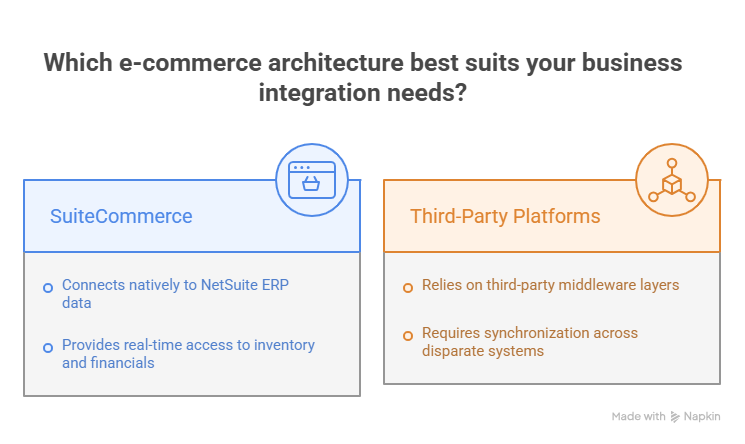
The businesses we work with reach the same conclusion eventually. If the ERP data is already in NetSuite, the store should be there too. That is what SuiteCommerce does. It is NetSuite’s native eCommerce platform, built inside the same system as the ERP, not connected to it through middleware.
Getting there requires a SuiteCommerce consultant who understands both the eCommerce experience your customers need and the NetSuite architecture underneath it.
This blog explains what SuiteCommerce consultants actually do, what the implementation process looks like, and how to choose the right partner for your project.
What Is a NetSuite SuiteCommerce Consultant?
A NetSuite SuiteCommerce consultant is a certified professional who designs, builds, and optimises eCommerce storefronts on the SuiteCommerce platform.
This is different from a general web developer or a generic eCommerce agency. SuiteCommerce is not a standalone platform. It runs inside NetSuite. Its data, products, inventory, pricing, customers, and orders live in the same database as your ERP records.
A SuiteCommerce consultant understands both sides:
- The front-end shopping experience your customers see
- The back-end NetSuite configuration that drives it
Without a consultant who knows both, businesses often end up with a store that looks right but behaves incorrectly:
- Pricing rules that do not fire properly for specific customer groups
- Inventory that does not reflect actual NetSuite stock levels
- Checkout flows that break when order management rules are applied
What Services Do SuiteCommerce Consultants Offer?
SuiteCommerce consulting covers more than initial implementation. A good partner is involved across the entire lifecycle of the store, from the first scoping call to ongoing post-launch support.
Here are the services that come up most frequently in projects we run.
SuiteCommerce Implementation
This is the core service. A consultant takes your business from no SuiteCommerce store to a live, functional storefront connected to NetSuite.
A full implementation covers:
- Requirements gathering and scope definition
- Architecture design
- Theme selection or custom theme development
- Product catalogue configuration
- Pricing and payment gateway setup
- Go-live support and post-launch monitoring
Timelines typically run 8 to 20 weeks, depending on the edition and customization scope.
SuiteCommerce Standard vs. Advanced Consulting
Choosing the right edition is one of the first decisions a consultant helps you make. It is not simply a question of budget. It is a question of what your store needs to do now and in the next three to five years.
SuiteCommerce Standard:
- Managed, hosted solution with automatic updates
- Defined feature set with configuration options
- Best for businesses that need a clean, functional store without deep customization
- Faster to deploy
SuiteCommerce Advanced:
- Full source code access
- Custom themes, custom logic, and deeper control over the shopping experience
- Updates must be managed by you or your partner
- Best for businesses with complex B2B requirements, unique checkout flows, or specific design needs
To see an honest side-by-side of what each edition includes, our blog on SuiteCommerce Standard vs. Advanced covers the pros and cons in practical terms.
Custom Feature Development
Many businesses need capabilities that SuiteCommerce does not include out of the box. These require SuiteScript, NetSuite’s JavaScript-based scripting environment.
Common custom features we build:
- Vehicle fitment lookup for automotive parts catalogues
- Custom B2B pricing portals with account-level visibility
- Loyalty program integrations
- Custom checkout flows with business-specific logic
- Custom reporting tied to SuiteCommerce order data
A SuiteCommerce consultant who develops in SuiteScript builds these directly inside the platform. No external app. No third-party plugin. The feature lives in the same system as everything else.
Our blog on custom features for SuiteCommerce stores explains the most common customizations growing businesses request and how they work technically.
Pricing Configuration and Rules
SuiteCommerce inherits NetSuite’s pricing engine directly. That means all of the following work natively:
- Customer-specific pricing
- Quantity breaks
- Promotional pricing
- Contract pricing
All of it runs through the same NetSuite price levels and price groups your sales team already uses. Configuring this correctly is more complex than it looks. A consultant who has mapped NetSuite pricing structures to SuiteCommerce display logic before knows exactly where the failure points are.
Our blog on implementing SuiteCommerce pricing and our overview of NetSuite SuiteCommerce pricing both cover this in depth.
Theme Development and Optimization
The visual design of a SuiteCommerce store runs through a theme: templates, stylesheets, and JavaScript that define how the store looks and behaves.
A consultant who builds custom themes understands both:
- The front-end design requirements your brand needs
- The SuiteCommerce template structure that powers them
A store built on inefficient templates will have performance issues at scale. A store built correctly loads fast, ranks well in search, and converts better.
Patch Management and Version Upgrades
SuiteCommerce Advanced stores require active maintenance. Oracle releases patches regularly to address:
- Security vulnerabilities
- Performance issues
- Compatibility with NetSuite platform updates
Applying patches incorrectly on a customized store can break existing functionality. A consultant who manages your patches reviews each release, tests it against your customizations in a sandbox, and applies it safely.
Our blog on SuiteCommerce patch management for Advanced users covers what this process involves and why it matters.
Migration From Other Platforms
Many businesses come to SuiteCommerce from Shopify, Magento, WooCommerce, or a custom-built store. A migration involves:
- Moving product data, customer records, and order history to SuiteCommerce
- Maintaining SEO rankings through proper redirect mapping
- Minimizing downtime during the cutover
A consultant who has done this migration before knows the data mapping challenges, the SEO requirements, and the testing checklist that prevents go-live surprises.
For stores moving to newer SuiteCommerce versions, the upgrade process is a consulting engagement in its own right. Our guide on upgrading to SMT Version 3 walks through what that involves for SuiteCommerce Advanced users.
Post-Launch Support and Optimisation
When your store goes live, you need to work on its vitals and make sure that there are no lags.
SuiteCommerce stores need ongoing attention:
- Performance monitoring
- Bug fixes and troubleshooting
- New feature development as the business grows
- Release management for NetSuite updates
- Conversion rate optimization
A consulting partner who stays engaged after go-live delivers more long-term value than one who hands over documentation and moves on.
What Are the Benefits of Working With a SuiteCommerce Consultant?
The benefits of hiring a SuiteCommerce consultant show up most clearly when you look at what goes wrong without one.
You Get a Store Configured Correctly From Day One
The most common problem we see in SuiteCommerce projects that were self-implemented or managed by a general web agency is misconfiguration. The store looks right. But:
- Pricing fires incorrectly for certain customer groups
- Inventory availability does not reflect NetSuite stock correctly
- Tax logic does not apply in the right jurisdictions
These problems are not visible until customers run into them. By then, you have already lost orders and customer trust. A consultant who has configured SuiteCommerce pricing, inventory display, and checkout logic many times before knows where these failures happen and prevents them during build.
Your NetSuite Data Drives the Store Automatically
When your store is built on SuiteCommerce and connected correctly to NetSuite:
- Pricing updates in NetSuite reflect on the store immediately
- Inventory adjustments update availability in real time
- New products added in NetSuite appear on the store without a manual sync
This is what businesses moving from Shopify or Magento with integration middleware are looking for.
You Avoid the Common Implementation Mistakes
Every SuiteCommerce implementation has predictable risk points:
- Pricing configuration for B2B customer groups
- Checkout flow logic for orders with multiple ship-to addresses
- Search and filtering performance on large product catalogues
A consultant who has seen these problems before builds with them in mind from day one.
You Get Access to SuiteScript Development Expertise
Custom SuiteCommerce features require SuiteScript, NetSuite’s proprietary JavaScript environment. This is a specialized skill. A general web developer cannot build SuiteScript customizations. A SuiteCommerce consultant who also develops in SuiteScript can extend the store without external dependencies.
Your Store Stays Current After Go-Live
A SuiteCommerce store that is not maintained degrades over time:
- Patches get missed
- Performance slips
- New NetSuite features go unconfigured
A consultant who provides ongoing support keeps the store current, secure, and working the way your business needs it to.
What Does the SuiteCommerce Implementation Process Look Like?
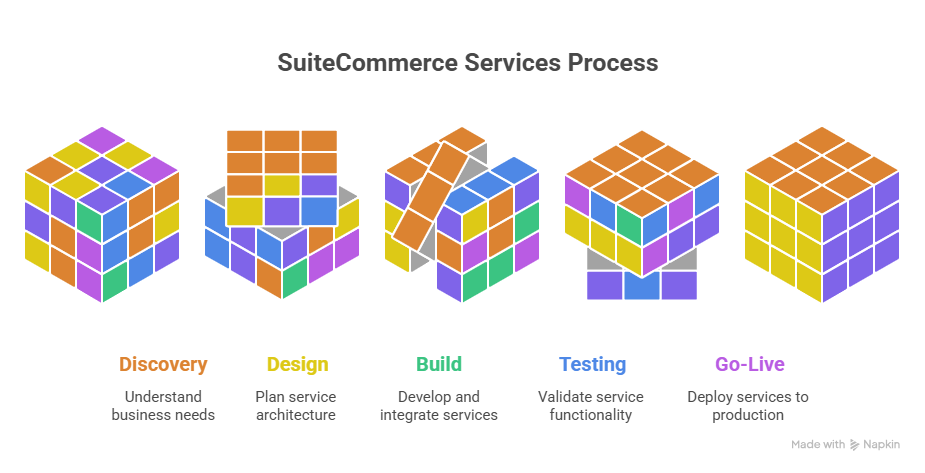
We use a four-phase process for every SuiteCommerce implementation. The phases stay the same whether we are building a Standard or an Advanced store. The depth of work in each phase scales with the scope.
Phase 1: Discovery and Requirements
This is the most important phase. It is also the one most often rushed.
Discovery covers your business requirements in full. We work through:
- What products do you sell and how are they structured in NetSuite
- Who your customers are: B2B, B2C, or both
- Which pricing rules apply to which customer groups
- What integrations the store needs to connect to
- What your order fulfilment process looks like
We also map the NetSuite configuration at this stage. Understanding how your items are set up, how pricing is structured, and which custom fields exist determines what is possible in the store without extra ERP configuration work.
At the end of discovery, there is a clear scope document. No ambiguity about what is being built. No features added mid-project that break the timeline.
Phase 2: Design and Architecture
Design covers two things at the same time:
Visual design: Layouts, typography, colour, imagery, and the overall shopping experience.
Technical architecture: Which SuiteCommerce template structures to use, how the data model maps to the front end, and how custom features will be built.
Both have to happen together. A design that looks right on a mockup but requires a non-standard template structure creates technical debt during build. A consultant who understands both sides catches those conflicts at the design stage, not after the build has started.
Phase 3: Build and Configuration
This is where the store gets built. What happens in this phase:
- Theme development
- Product catalogue configuration
- Pricing and payment gateway setup
- Shipping configuration
- Custom SuiteScript development for bespoke features
Everything is built in a NetSuite sandbox environment. Every feature is tested against the live NetSuite data structure before it goes anywhere near production. That testing catches the configuration errors that cause go-live surprises.
Phase 4: Testing, Training, and Go-Live
Before the store goes live, it goes through a structured testing cycle:
- Functional testing: Every user journey, including search, product detail, add to cart, checkout, and order confirmation
- Performance testing: Store load speed under expected traffic
- Regression testing: Confirming no existing NetSuite processes were affected
Training for your team covers store management: how to update products, manage promotions, and run performance reports. A team that knows its store does not need a consultant every time they want to change a banner.
Go-live includes a DNS cutover plan, a monitoring period, and a post-launch checklist.
Now you have a full-fledged picture of SuiteCommerce, below are a few of the success stories we suggest you go through. Folio3 implemented SuiteCommerce and its editions for companies across different verticals. Let’s have a glance.
What Do Real SuiteCommerce Implementations Look Like?
The details of what we have built for clients are more useful than any general description. Here are four implementations across different industries.
Eravant – SuiteCommerce Advanced for RF and Microwave Components
Industry: Defense, aerospace, and telecommunications
Challenge: Highly technical product catalogue where specifications matter enormously to engineers making purchasing decisions
Folio3 implemented SuiteCommerce Advanced for Eravant, building a store that surfaces technical product data, frequency ranges, connector types, and power handling specs, in a format engineers can evaluate and purchase directly.
The store connects to NetSuite inventory and pricing, giving technical buyers accurate availability and contract pricing without a sales conversation for every order.
ABC Parts – Custom Fitment Lookup for Automotive Parts
Industry: Wholesale automotive parts distribution
Challenge: Buyers needed to search for parts by vehicle year, make, and model, integrated directly with NetSuite inventory
Folio3 built a custom fitment table with a pop-up search window on sales transactions. When a customer finds a part by vehicle, it moves directly into a NetSuite-managed order process.
Read the ABC Parts success story for the full technical scope.
Team Litzen – SuiteCommerce for B2B Wholesale
Industry: B2B wholesale Challenge: Customer-specific pricing and account management needed to reflect correctly in the online buying experience
Folio3 built a SuiteCommerce store that pulls Team Litzen’s NetSuite pricing structures, customer-specific price levels, volume breaks, and account terms directly into the store.
Read the Team Litzen success story to see how B2B pricing was mapped from NetSuite to the store.
BioPak – Multi-Region SuiteCommerce for Sustainable Packaging
Industry: Compostable and sustainable foodservice packaging Challenge: Multi-currency support, region-specific product catalogues, and B2B buying experience across Australia, New Zealand, and the UK
Folio3 rebuilt BioPak’s eCommerce store on SuiteCommerce and connected it to NetSuite’s multi-subsidiary structure. The result is a buying experience that matches how their B2B customers actually purchase.
Read the BioPak NetSuite success story to see how multi-region eCommerce was managed inside a single NetSuite environment.
How Much Does SuiteCommerce Consulting Cost?
SuiteCommerce implementation cost varies based on several factors. There is no flat industry rate. Here is what drives the number.
| Cost Factor | Lower End | Higher End |
|---|---|---|
| Edition | SuiteCommerce Standard | SuiteCommerce Advanced |
| Theme | Standard theme with configuration | Fully custom theme development |
| Customizations | Minimal (configuration only) | Multiple SuiteScript custom features |
| Integrations | NetSuite only | Third-party payment, shipping, ERP add-ons |
| Data migration | Clean product catalogue | Complex migration from existing store |
| Training | Basic user training | Full team training across multiple roles |
Typical ranges:
- SuiteCommerce Advanced mid-market implementation: $40,000 to $120,000
- SuiteCommerce Standard with moderate customization: $20,000 to $50,000
These figures cover the implementation project only. Ongoing support, patch management, and optimization are separate costs.
How Do You Choose the Right SuiteCommerce Consultant?
Not every NetSuite partner has deep SuiteCommerce experience. NetSuite ERP implementation and SuiteCommerce implementation are different skill sets. A partner who is excellent at ERP may not have the front-end development, SuiteScript, or eCommerce experience that a SuiteCommerce project requires.
Here is what to look for:
- Certified SuiteCommerce developers on the team
Ask specifically whether the partner has certified SuiteCommerce developers, not just NetSuite consultants. You want developers who work in SCA, SuiteScript, and the SuiteCommerce template structure on a regular basis.
- A portfolio of completed SuiteCommerce stores
Ask for examples of stores they have built. Not general NetSuite case studies. SuiteCommerce stores that are live and can be reviewed. Ask what the custom development scope was, what challenges came up, and how they were resolved.
If you want an honest view of how we work, our Clutch reviews highlight real client experiences across projects.

- Experience with your business model
B2B and B2C SuiteCommerce implementations are very different. A partner who has built B2B stores with complex pricing logic has a different experience from one who has built clean B2C retail stores. The portfolio should match your business model.
- Post-go-live support included
Ask what happens after the store goes live. Do they offer ongoing support? How do they handle patch management? What is the SLA for post-launch issues?
Why Folio3 is the right Choice For You?
Choosing the right SuiteCommerce consultants is what decides whether your project runs smoothly or turns into a long list of fixes after go-live. Many partners can implement a store. Fewer understand how SuiteCommerce Advanced actually works under the hood.
SCA is not just a frontend project. It sits on top of NetSuite ERP. Every customization, extension, and workflow touches inventory, pricing, and order data. That is why you need consultants who think beyond design and focus on how the system behaves end to end.
Folio3 works as a hands-on SuiteCommerce consulting team. The focus stays on building a stable, scalable ecommerce system that connects cleanly with your ERP from day one.
What sets Folio3 apart
a. Certified SuiteCommerce consultants
The team works across both SuiteCommerce and NetSuite ERP. This ensures every customization supports real business workflows, not just frontend changes.

b. Structured implementation approach
Projects follow a clear, milestone-based plan. This keeps timelines predictable and reduces rework during and after launch.
c. Business-focused customizations
B2B portals, bulk pricing, quote workflows, and checkout logic are built around how your customers actually buy.
d. Performance-led design
UX decisions are based on speed, usability, and conversion. The goal is to improve how users move from product discovery to checkout.
e. Ongoing consulting and optimization
Post-go-live support focuses on performance tuning, feature improvements, and scaling your store as operations grow.
Bottom Line
SuiteCommerce is a capable eCommerce platform. For businesses already on NetSuite, it removes the integration layer between the store and the ERP entirely. Inventory, pricing, orders, and customer data all live in one system.
Getting there requires a consultant who understands both sides: the eCommerce experience your customers need, and the NetSuite architecture underneath it.
The businesses we have worked with, from RF component manufacturers to automotive parts distributors to sustainable packaging companies, share the same outcome. A store that runs on accurate, real-time data from NetSuite, without a team manually keeping two systems in sync.
If that is the outcome you are looking for, reach out to the Folio3 team. We will give you a straight answer on what it takes to get there for your specific operation.
FAQs
Q: What does a NetSuite SuiteCommerce consultant do?
A SuiteCommerce consultant designs, builds, and configures eCommerce storefronts on NetSuite’s SuiteCommerce platform. This includes requirements gathering, theme development, pricing configuration, custom SuiteScript development, testing, go-live support, and post-launch optimization. Unlike a general web developer, a SuiteCommerce consultant understands both the front-end store experience and the NetSuite back end that drives it.
Q: How long does a SuiteCommerce implementation take?
SuiteCommerce Standard with moderate customization typically takes 8 to 12 weeks. SuiteCommerce Advanced with custom theme development and SuiteScript features typically takes 14 to 20 weeks. Complex projects with significant data migration or multiple integrations take longer. Scope clarity at the start of the project is the biggest factor in keeping timelines on track.
Q: Should I choose SuiteCommerce Standard or Advanced?
If you need a clean, functional store that launches quickly and updates automatically, Standard is the right starting point. If you need custom theme design, unique checkout flows, complex B2B pricing displays, or features that do not exist out of the box, Advanced gives you the flexibility to build them. A consultant will help you map your specific requirements to the right edition before the project begins.
Q: How does SuiteCommerce connect to NetSuite?
SuiteCommerce is native to NetSuite. It does not require a separate integration. Product data, inventory levels, customer records, pricing, and order management all live in the same NetSuite database. When inventory changes in NetSuite, the store reflects it immediately. When an order is placed in the store, it creates a NetSuite sales order automatically. There is no middleware, no sync schedule, and no integration to maintain.
Q: What ongoing support does a SuiteCommerce store need after go-live?
SuiteCommerce Advanced stores need patch management, performance monitoring, and feature development as the business grows. SuiteCommerce Standard stores need configuration updates and optimization. Both benefit from a consulting partner who reviews the store periodically, manages NetSuite release impacts, and adds features as requirements change.
Q: How do I get started with Folio3’s SuiteCommerce consulting services?
The first step is a scoping conversation where we review your current eCommerce setup, your NetSuite configuration, and what you need the store to do. From there, we provide a scoped implementation plan with a timeline and cost estimate. Start the conversation today.