Key Takeaways
- NetSuite lease accounting handles ASC 842 and IFRS 16 compliance through the Fixed Asset Module. This automates ROU asset creation, amortization schedules, interest calculations, and journal entries in one place.
- Operating and finance leases follow different accounting treatments on your income statement and balance sheet. Misclassifying one for the other produces financial statements that misrepresent both your expenses and your debt obligations.
- Lease modifications, term extensions, and payment renegotiations are remeasurement events that change both your ROU asset and lease liability. Getting these right in NetSuite requires a process and not just data entry.
Think about a credit card you have been carrying for years. Every month you pay the minimum, the balance stays roughly the same, and you never quite see the full weight of what you owe because it never appears as a single line on your personal balance sheet.
Now imagine your auditor walks in, adds up every future payment you have committed to across every lease your company holds, and puts that number on the balance sheet as a liability.
That is exactly what ASC 842 and IFRS 16 did to lease accounting. And for many finance teams, the first full picture of their lease obligations was not a comfortable one.
According to the IASB, 85% of the estimated $3.3 trillion in global lease commitments were not reflected on company balance sheets before these standards came into force. Before you assume anything, that is not a rounding error. For investors and auditors, it meant they were reading financial statements that systematically understated what companies actually owed.
If your team is still managing NetSuite lease accounting through a spreadsheet, or if your compliance setup has never been properly reviewed since your initial implementation, this guide covers everything you need to get it right, from the fundamental standard differences to how NetSuite automates the calculations that used to take days.
What Is Lease Accounting and Why Did the Rules Change?
Lease accounting is the process of recording lease agreements as financial obligations on your company’s books. Under the old standards (ASC 840 for US GAAP, IAS 17 for international), operating leases stayed off the balance sheet entirely. A company could sign a ten-year office lease worth millions, and none of that obligation would appear as a liability. Investors had no way to measure it. Auditors had to rely on footnotes.
The new standards changed that completely:
- ASC 842 (issued by FASB, effective for US public companies from 2019, private companies from 2020) requires lessees to recognize a right-of-use asset and a corresponding lease liability on the balance sheet for virtually all leases longer than 12 months
- IFRS 16 (issued by IASB, effective from January 2019) does the same, but goes further by treating every lease as a finance lease on the lessee’s books, with no operating lease classification at all
The practical result is that your balance sheet now reflects the full picture of your lease commitments. For most mid-market companies, that means a significantly longer asset register and a correspondingly larger liability balance than the books showed before.
For context on how lease accounting fits within NetSuite’s broader financial management capabilities, our guide to NetSuite finance modules covers where the Fixed Asset Module sits alongside the rest of the financial stack.
Operating Lease vs. Finance Lease: What Is the Difference and Why Does It Matter?
This is the classification decision that shapes how every lease appears in your financial statements. Getting it wrong does not just affect your balance sheet. In fact,t also changes your EBITDA, your interest expense, and how auditors read your debt ratios.
Operating lease
You use the asset but transfer no ownership risk. The accounting treatment is as follows:
- ROU asset and lease liability both appear on the balance sheet
- P&L shows a single straight-line rent expense each period
- EBITDA is unaffected because the expense sits below operating income
- Cash flow shows the payment as an operating cash outflow
Finance lease
Effectively, an ownership transfer, either because the lease covers most of the asset’s useful life, transfers title, or gives you an option to purchase at a bargain price. The accounting treatment is as follows:
- ROU asset depreciated separately, and interest accrued on the liability
- P&L shows depreciation plus interest expense front-loaded, meaning higher total expense in early years
- EBITDA is reduced by depreciation
- Cash flow splits the payment between operating (interest) and financing (principal)
Under IFRS 16, there is no operating lease classification for lessees. Every lease follows the finance lease model regardless of the underlying economics. This is the most important practical difference between ASC 842 and IFRS 16, and it is the reason dual-reporting companies face added complexity.
ASC 842 vs. IFRS 16: Key Differences for Companies Reporting Under Both
If your company reports under both US GAAP and IFRS, you already know that the same lease can produce different numbers depending on which standard you apply it to. The three differences that matter most in practice are:
Lease classification: ASC 842 retains the operating vs. finance distinction for P&L presentation. IFRS 16 applies a single model where all leases are treated as finance leases on the lessee’s books. The balance sheet presentation is similar; the income statement and cash flow presentation differ.
Short-term exemption: Both standards allow a 12-month exemption for leases with terms at or below that threshold. The mechanics differ slightly, but the practical impact is the same: you can keep short-term leases off the balance sheet.
Low-value asset exemption: IFRS 16 provides an additional exemption for leases of low-value assets (commonly defined as assets with a value under $5,000 when new). ASC 842 has no equivalent.
For companies that need to maintain parallel books under both standards, NetSuite’s Multi-Book Accounting handles this by running separate accounting treatments for the same lease under each framework simultaneously. Our guide to NetSuite multi-entity accounting covers how multi-book works in practice for companies with dual reporting obligations.
How NetSuite Handles Lease Accounting Through the Fixed Asset Module
NetSuite processes lease accounting through the Fixed Asset Module (FAM). This is where leases are created, classified, scheduled, and posted to the GL. Here is what it automates once a lease record is set up correctly:
- ROU asset creation: NetSuite calculates the present value of all future lease payments using the incremental borrowing rate (IBR) you input, then creates the ROU asset at that value
- Amortization schedule generation: the full amortization table, showing principal, interest, and carrying value for every period of the lease term, is generated automatically. Existing schedules can be imported if you are migrating from a previous system
- Journal entries: monthly depreciation and interest entries post automatically without manual intervention. The GL impact differs by lease classification; operating leases post a single rent expense line, and finance leases post separate depreciation and interest lines
- Compliance reports: balance sheet updates with ROU asset and lease liability values, cash flow statement, and disclosure schedules for audit requirements, all generate from the same lease record
Short-term and low-value exemptions are handled within the setup. Leases you designate as short-term, or low-value, are excluded from balance sheet recognition and expensed directly. NetSuite tracks these separately, so your disclosure schedules remain accurate.
To understand how the Fixed Asset Module connects to the broader module ecosystem, our guide to NetSuite add-on modules covers the full scope of what FAM touches within a NetSuite deployment.
Lease Modifications and Remeasurement: What Happens When Terms Change?
Here is a scenario that comes up more often than you might expect. Your company is three years into a five-year office lease. The landlord agrees to extend the term by two more years in exchange for a modest rent increase. You sign the amendment, file it, and move on.
Under ASC 842, what just happened is not just a paperwork change. It is a remeasurement event. The extension changes the lease term, which changes the present value calculation, which changes both your ROU asset balance and your lease liability on the balance sheet. Every modification needs to be reflected in the system on the modification date, not at the next annual review.
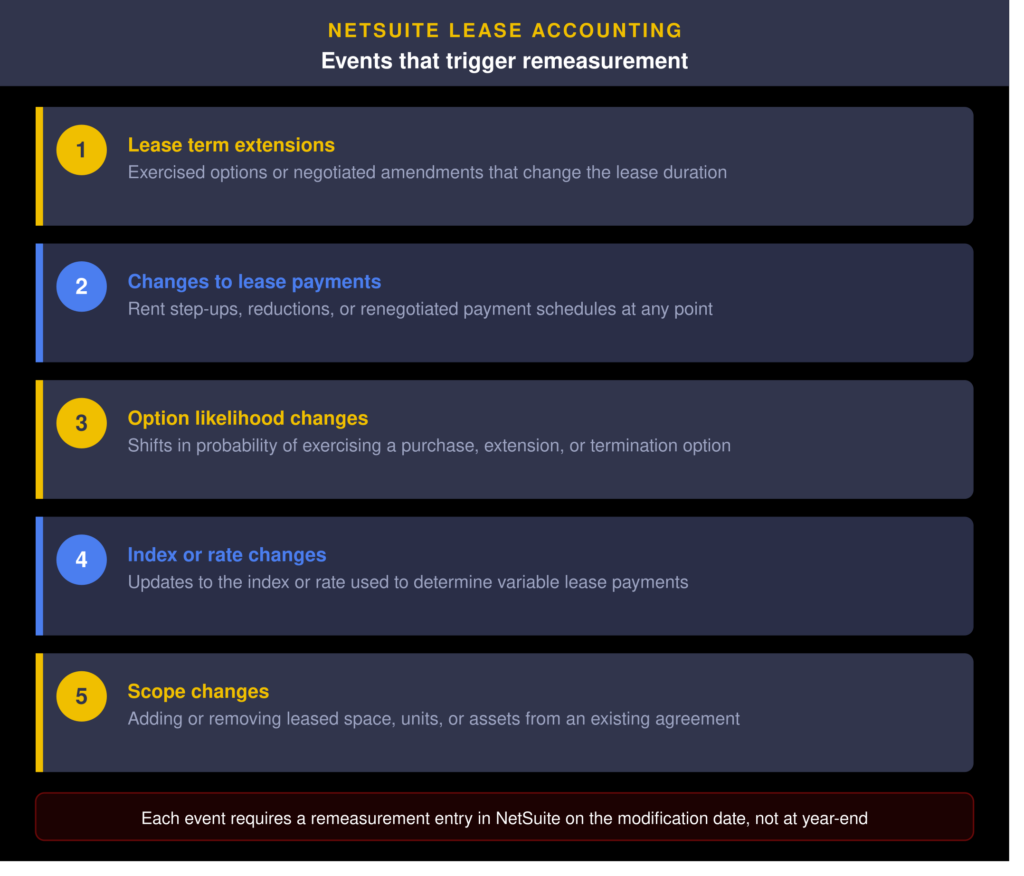
When a modification is recorded in NetSuite’s FAM, the system recalculates the present value from the modification date using the updated inputs, generates a new amortization schedule for the remaining term, and posts the adjustment entry to the ROU asset and liability accounts. The prior schedule is closed out as of the modification date.
Hani, our ERP Consulting Manager, flags lease modification handling as the most common gap he sees in existing NetSuite lease accounting setups. He told us that teams set up the initial lease records correctly during implementation, but have no documented process for what to do when terms change. The result is that modifications get processed late, or not at all, which means the balance sheet carries incorrect ROU asset and liability values until the next audit flags it.
Industry-Specific Lease Accounting Patterns
Lease accounting complexity varies significantly by industry. The same module configuration that works for a technology company with two office leases will not be sufficient for a retail chain managing hundreds of store leases or a manufacturing company with specialized equipment financing.
Real estate and property management
Multi-property lease portfolios involve ground leases, subleases, and leases with variable rent components tied to property revenue. Subleases require the company to account as both lessor and lessee simultaneously. Variable rent components (percentage rent in retail-anchored property, for example) require separation from fixed payments in the lease record.
We conducted an in-depth survey with our clients and a UK-based land and estate management firm managing operations across multiple property types reported eliminating approximately 40 hours of annual manual paper filing after implementing structured lease record management and digital approval workflows in NetSuite. The same firm, consolidating 22 entities onto a single NetSuite platform, reported reducing invoice processing time by 66% per transaction and shaving 10 working days off their month-end close cycle
Retail
Store lease portfolios are where ASC 842 complexity scales fastest. A retailer with 200 locations has 200 individual lease records, each potentially with different terms, variable rent clauses, renewal options, and modification histories.
The challenge is not the accounting treatment for any single lease. In fact, t is keeping 200 records current as stores renegotiate terms and markets change. NetSuite’s ability to import amortization schedules in bulk and run automated monthly entries across the full portfolio is what makes this manageable at scale.
Manufacturing
Equipment leases in manufacturing commonly trigger finance lease classification because the leased asset typically covers most of the equipment’s useful life, or the company has a bargain purchase option at the end of the term.
Finance lease treatment means a higher early-year expense and a larger impact on EBITDA compared to operating lease treatment. Getting the classification right at the outset matters because reclassifying a large equipment lease mid-term requires retroactive adjustment of the amortization schedule.
PE-backed and multi-entity companies
Private equity-backed companies preparing for audit or eventual exit need clean, complete lease records that produce auditable disclosures without manual assembly.
A real estate fund management firm we work with reported that moving financial management from fragmented spreadsheets into a unified NetSuite environment directly reduced the time required to close out financial reporting periods, with the lease record structure being one of the components that had previously required the most manual intervention.
Common NetSuite Lease Accounting Mistakes
The Folio3 NetSuite implementation team reviews lease accounting setups as part of every audit engagement. The same five mistakes appear repeatedly, regardless of company size or industry.
Misclassifying the lease type
Using operating lease treatment for a finance lease understates interest expense and overstates EBITDA. The classification criteria under ASC 842 are specific: if any one of five conditions is met, it is a finance lease. These criteria need to be checked at lease commencement, not assumed.
A lease is classified as a finance lease when any one of the following is true:
- The lease transfers ownership of the underlying asset to the lessee by the end of the lease term
- The lease grants the lessee an option to purchase the underlying asset that the lessee is reasonably certain to exercise
- The lease term covers the major part of the remaining economic life of the underlying asset (generally interpreted as 75% or more)
- The present value of lease payments and any residual value guaranteed by the lessee equals or exceeds substantially all of the fair value of the underlying asset (generally interpreted as 90% or more)
- The underlying asset is so specialized in nature that it is expected to have no alternative use to the lessor at the end of the lease term
If none of these five conditions are met, the lease is classified as an operating lease under ASC 842.
Using the wrong incremental borrowing rate
The IBR should reflect the rate the company would pay to borrow a similar amount over a similar term with similar collateral. Using a generic company-wide rate or a rate from a different borrowing context produces a present value calculation that is wrong from day one.
Missing non-lease components
Many lease contracts bundle service charges, maintenance fees, and property insurance into a single payment. Under ASC 842, these non-lease components must be separated from the lease payment before calculating the present value. Failing to separate them inflates the ROU asset and liability.
No process for modification events
The initial setup is completed correctly, but nobody owns the process for updating lease records when terms change. Modifications go unrecorded until an auditor finds the discrepancy.
Incorrect transition entries
Companies migrating from spreadsheet-based lease tracking to NetSuite often bring opening balances across incorrectly, either using the wrong transition date or failing to match the ROU asset to the liability net of initial direct costs and prepaid rent.
Migrating from Spreadsheets to NetSuite Lease Accounting
If your team is currently tracking lease obligations in Excel alongside NetSuite, you are not starting from zero when you move to native lease accounting. You are migrating an existing portfolio of leases that are already mid-term, each with an amortization schedule that needs to carry over correctly.
The transition requires:
- A lease inventory: every lease in scope for ASC 842 or IFRS 16, with commencement date, original term, payment schedule, and the IBR that was applicable at commencement
- An import of existing amortization schedules: NetSuite accepts amortization schedule imports, which means you do not have to re-derive the present value calculation from scratch for mid-term leases
- Opening balance journal entries: the ROU asset and lease liability need to be loaded onto the balance sheet at the transition date, with corresponding retained earnings or prior period adjustment entries depending on the transition method chosen
- Transition method decision: modified retrospective (simpler, no prior period restatement) vs. full retrospective (comparative periods restated, more complex but cleaner for IPO or M&A preparation)
The data quality requirement is more demanding than most teams expect. Missing commencement dates, inconsistent payment schedules, and IBRs that were never formally documented are the three most common data problems that slow down or invalidate a lease accounting migration.
Our guide to NetSuite GL best practices covers how the GL structure needs to be set up to receive lease accounting entries correctly, particularly for companies managing multi-entity portfolios.
Getting NetSuite Lease Accounting Right Before the Auditors Do
Lease accounting under ASC 842 and IFRS 16 is not a one-time setup. It is an ongoing process that requires modification tracking, periodic remeasurement, correct classification at commencement, and disclosure schedules that hold up to audit scrutiny. The companies that get this right are the ones that built the process around the setup, not just the setup itself.
If your current lease records have not been reviewed since your initial implementation, or if your team is still managing modifications and remeasurements outside of NetSuite, that gap will surface at the next audit. Getting ahead of it now is considerably less work than fixing it under time pressure.
To explore how Folio3 structures NetSuite lease accounting implementations, including the lease inventory audit, classification review, and migration process, visit the NetSuite consulting services page. If you want to understand the full range of NetSuite modules relevant to your finance function, the NetSuite modules overview covers the Fixed Asset Module alongside the rest of the financial management stack.
People Also Ask
What is NetSuite lease accounting?
NetSuite lease accounting refers to how NetSuite’s Fixed Asset Module handles the recognition, measurement, and reporting of lease agreements under ASC 842 (US GAAP) and IFRS 16 (international standards). The module automates ROU asset creation, amortization schedule generation, interest calculations, and monthly journal entries. It also generates the compliance reports and disclosure schedules required for audit purposes under both standards.
Does NetSuite support ASC 842 compliance natively?
Yes. NetSuite handles ASC 842 compliance through the Fixed Asset Module. It calculates the present value of lease payments using the incremental borrowing rate, creates the right-of-use asset and corresponding lease liability, generates a full amortization schedule, and posts automated journal entries each period. Existing amortization schedules from prior systems can be imported for mid-term leases during transition.
What is the difference between an operating lease and a finance lease under ASC 842?
Under ASC 842, an operating lease is one where the lessee uses the asset without effectively acquiring ownership. The income statement shows a straight-line rent expense, and the cash flow is classified as operating. A finance lease transfers substantially all ownership risks to the lessee. The income statement shows separate depreciation and interest expense (front-loaded), and the cash flow is split between operating and financing components. The classification affects EBITDA and debt ratios, which is why correct classification matters at lease commencement.
How does NetSuite handle IFRS 16 lease accounting?
NetSuite handles IFRS 16 through the same Fixed Asset Module used for ASC 842, but applies the IFRS 16 single-model treatment where all leases are accounted for as finance leases on the lessee’s books. For companies that report under both US GAAP and IFRS, NetSuite’s Multi-Book Accounting maintains separate books for each standard against the same underlying lease record, producing compliant financial statements for each framework without duplicate data entry.
What is a right-of-use asset in NetSuite?
A right-of-use asset in NetSuite is the asset created when a lease is recognized on the balance sheet under ASC 842 or IFRS 16. It represents the lessee’s right to use the underlying asset for the lease term. NetSuite calculates the ROU asset value as the present value of all future lease payments, adjusted for initial direct costs, lease incentives, and any prepaid rent. The asset is then amortized over the lease term with monthly entries posted automatically.
How does NetSuite handle lease modifications and remeasurements?
When a lease term extends, payments change, or an option is exercised, NetSuite processes this as a remeasurement event. You update the lease record with the new terms and modification date, and the system recalculates the present value using updated inputs, generates a new amortization schedule from the modification date forward, and posts the adjustment entry to both the ROU asset and lease liability accounts. The original schedule closes out as of the modification date.
What are the most common NetSuite lease accounting mistakes?
The five most common are: misclassifying a finance lease as an operating lease, using an incorrect incremental borrowing rate for the present value calculation, failing to separate non-lease components (service charges, maintenance) from the lease payment before calculating present value, having no documented process for recording lease modifications when terms change, and importing incorrect opening balance entries during the transition from spreadsheet-based tracking to NetSuite.
Can NetSuite handle both ASC 842 and IFRS 16 simultaneously?
Yes. For companies with dual reporting obligations under US GAAP and IFRS, NetSuite’s Multi-Book Accounting functionality maintains parallel books for the same lease under each standard. ASC 842 retains the operating vs. finance lease classification, while IFRS 16 applies the single finance lease model. NetSuite processes the differences in income statement presentation and cash flow classification separately per book, producing compliant financial statements for both frameworks from a single data entry point.