NetSuite’s Cloud ERP system goes above and beyond the essentials of running an e-commerce store, tracking inventory, and generating reports. It’s got you covered with a crucial feature that most businesses need: NetSuite credit card processing.
NetSuite offers various convenient ways to accept credit card payments. Businesses can effortlessly manage their back-end and sales operations through point-of-sale, online transactions, or mobile sales through its all-in-one system. This helps save costs and reduce time spent.
There’s so much more to discover about Credit Card Processing in NetSuite! Let’s dive into it together through this blog.
Key Takeaways
- 71% of all card fraud losses come from CNP transactions (ecommerce, phone, mail orders), making secure processing critical.
- Credit card processing in NetSuite uses PCI-DSS compliant encryption, fraud screening, and automated reconciliation to reduce manual work.
- Chargeback rates surged 222% between Q1 2023 and Q1 2024, with chargebacks costing merchants an average of $110 in fees and labor per event.
- Integrating payment processing with NetSuite eliminates manual reconciliation, reduces errors, and accelerates cash flow.

Understanding the Payment Fraud Landscape
The Scale of the Problem
Payment fraud has become one of the largest financial threats facing ecommerce businesses. In 2024, ecommerce companies faced losses that demand immediate attention:
- $48 billion lost annually to fraud in ecommerce globally
- $4.61 cost multiplier: for every $1 in fraud, merchants lose $4.61 including chargebacks, fees, and labor
- 71% of fraud losses come from card-not-present (CNP) transactions—ecommerce, phone, and mail orders
- Chargebacks surged 222% between Q1 2023 and Q1 2024, representing the steepest increase in industry history
- Average chargeback cost: $110 per event in fees, labor, and lost goods
For small to mid-size businesses, these numbers are catastrophic. Fraud costs consume margins, damage customer relationships, and can force business closure if not controlled.
Types of Fraud Targeting Ecommerce
Understanding the fraud types helps explain why secure payment processing is non-negotiable:
- Card-not-present (CNP) fraud: The attacker has stolen credit card data and makes unauthorized purchases online. This is the largest fraud category, accounting for 71% of card fraud losses and $10 billion in 2024 losses alone.
- Friendly fraud: A legitimate customer disputes a valid transaction claiming the item didn’t arrive or doesn’t match the description. 72% of merchants reported increased friendly fraud in 2024, with estimates that 40-80% of total fraud losses come from this type.
- New account fraud: Criminals use stolen identity data to open new credit card accounts. This grew 88% year-over-year in 2024.
- Synthetic identity fraud: Fraudsters blend stolen and fabricated data to create fake identities, making detection harder.
Why NetSuite Credit Card Processing Matters
Security and Compliance Built In
NetSuite’s credit card processing meets the highest industry security standards. All sensitive payment data is encrypted, tokenized, and stored securely to maintain PCI-DSS (Payment Card Industry Data Security Standard) compliance. This means:
- Customer card numbers are never stored in plain text
- Encryption protects data in transit and at rest
- Tokenization replaces sensitive data with secure tokens for repeat transactions
- Compliance burden is reduced as NetSuite handles much of the security infrastructure that would otherwise fall on your team
Automated Fraud Detection
NetSuite integrates CyberSource’s Decision Manager for advanced fraud screening. The system:
- Runs transactions through risk algorithms before approval
- Flags high-risk orders for manual review based on your rules
- Provides customizable approval workflows so invalid orders never leave your review queue
- Supports level II and level III purchase card processing to optimize fees for different transaction types
Elimination of Manual Reconciliation
When payment processing is fragmented across multiple systems, your accounting team spends weeks manually matching payments to invoices. With NetSuite integrated payment processing:
- Payments are captured automatically when transactions are approved
- Customer payment records are created instantly without manual data entry
- Reconciliation happens automatically as payments settle
- Cash flow visibility is real-time, not a week-old spreadsheet
NetSuite Credit Card Processing Terms
- Gateway: Think of the gateway as the secure online bridge between your business and the payment system. It helps your online store communicate payment details safely, like a virtual cash register for Internet transactions.
- Processor: The processor acts as a middleman. It’s like the liaison between your business, the customer’s card, and the banks. It ensures that transactions are approved and the money smoothly moves from the customer to your business.
- Acquirer: The acquirer is the financial institution (bank) that manages your business account. The bank handles and settles the transactions made with credit or debit cards in your store, ensuring the money ends up in your business account.
Customer Credit Card Processing
NetSuite’s integrated credit card processing is a handy tool that helps efficiently handle credit card payments for your sales orders and website purchases. It simplifies the process, from authorizing cards to managing potential fraud and capturing funds for transactions where the card is not physically present.
Here are the key advantages of using NetSuite credit card processing integration:
Secure Transactions: Your customers’ card numbers are encrypted to ensure full compliance with PCI standards, and their data is stored securely.
Smooth Integration: The system seamlessly integrates with your sales orders, whether from mail or telephone orders (MOTO) or online purchases. This integration streamlines the approval and fund capture process.
Optimized Processing: For cost savings, the system supports payer authentication and level II and level III purchase card processing. This helps optimize the processing costs associated with different types of transactions.
Order Review: You can place holds on payments to review orders for validity before proceeding. This helps in preventing potentially problematic transactions.
Fraud Management: Leveraging CyberSource’s Decision Manager, the system provides tools for effective fraud management, adding an extra layer of security to your transactions.
Enhanced Reporting: By mapping sales order data to CyberSource reporting fields, you gain more insightful and detailed reports, helping you make informed decisions.
Statement Clarity: Soft descriptors are available, making it easy for your customers to identify and understand the transactions on their credit card statements.
Additionally, if you work with CyberSource or MerchantE, you can establish rules to ensure that only valid and credit-worthy orders are approved. Orders that don’t meet your approval criteria can be flagged for review, allowing you to assess them individually or in bulk. CyberSource’s Decision Manager offers extra verification tests and services to enhance your fraud management efforts further.
NetSuite Credit Card Processing Flow
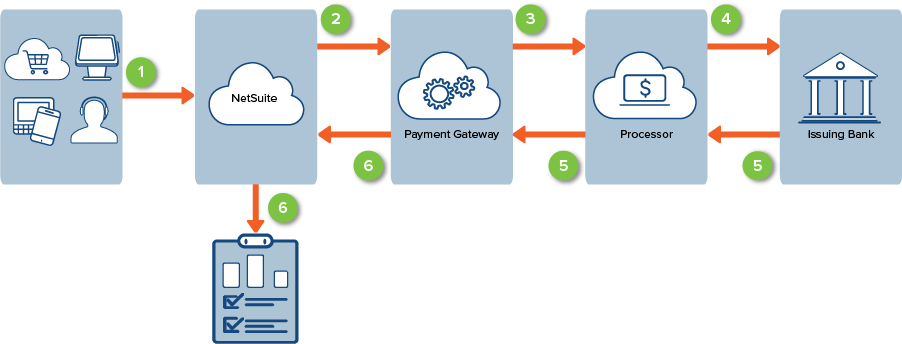
This diagram showcases the credit card authorization process and how NetSuite communicates with the payment gateway.
Customer Orders: Someone buys something.
NetSuite Sends Request: Where they bought it sends details securely to a payment gateway.
Payment Gateway Talks to Bank: The payment gateway communicates with the bank as a middleman.
Bank Checks Funds: The bank checks for the purchase if there’s enough money.
Bank Approves or Denies: The Bank decides whether to approve (yes) or decline (no).
Result Goes Back to NetSuite: The payment gateway informs NetSuite of the bank’s decision.
NetSuite Updates Order: If approved, NetSuite updates the order status for further processing.

Transferring Credit Card Funds
The following diagram illustrates the funds settlement (capture) process:
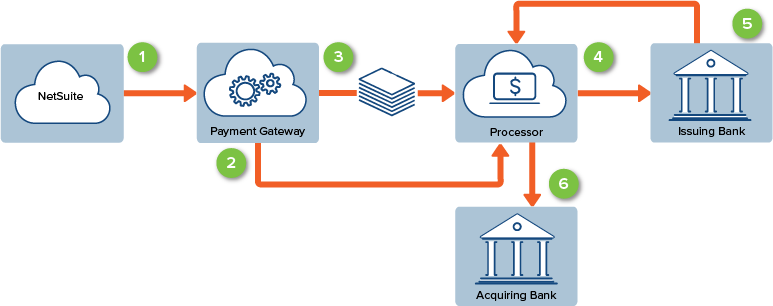
- Sales orders billed in NetSuite trigger capture requests to the payment gateway.
- Payment gateway checks and reauthorizes funds with the issuing bank if needed.
- Approved funds are added to the daily batch sent to the issuing bank.
- The issuing bank verifies and transfers funds to the acquiring bank.
- Acquiring bank credits to the merchant’s account.
Choosing the Right NetSuite Payment Processor
NetSuite supports multiple payment gateway and processor integrations. Choosing the right one requires evaluating several factors:
1. Seamless NetSuite Integration
Not all payment processors integrate equally with NetSuite. Look for processors that:
- Sync transaction data automatically to NetSuite without manual entry
- Support real-time API connections for instant transaction processing
- Update order status and customer records automatically
- Provide reporting that maps directly to NetSuite’s financial structure
NetSuite’s ecosystem includes native integrations and pre-built connectors for major processors. See NetSuite payment gateway integration options for a detailed comparison of available integrations.
2. PCI-DSS Compliance and Security
Payment processing involves sensitive customer financial data. Your processor must:
- Maintain current PCI-DSS Level 1 certification
- Use encryption and tokenization to protect card data
- Provide tokenized card-on-file storage for recurring billing
- Support 3D Secure authentication for additional fraud prevention
- Conduct regular security audits and penetration testing
3. Payment Method Flexibility
Customers expect multiple payment options. Your processor should support:
- Credit and debit cards (Visa, Mastercard, American Express, Discover)
- Digital wallets (Apple Pay, Google Pay, PayPal)
- ACH transfers and bank-to-bank payments
- Recurring and subscription billing
- Invoicing and “pay later” options
4. Transparent Fee Structure
Payment processing fees vary significantly. Compare:
- Per-transaction fees (typically 2-3% for standard merchants)
- Monthly minimum charges
- Chargeback fees (typically $25-$100 per dispute)
- Batch processing fees
- Hidden fees that accumulate (e.g., address verification, CVV verification)
For a thorough guide to evaluating payment processors for NetSuite, see the business owner’s guide to NetSuite payment processing features.
Final Thoughts
NetSuite credit card processing transforms payment handling from a fragmented, manual process into an automated, secure workflow integrated with your entire ERP system. By centralizing payment processing, fraud detection, and reconciliation, you reduce operational costs, minimize fraud losses, and accelerate cash flow.
The combination of PCI-DSS compliance, automated fraud screening, and real-time reconciliation means your team can focus on growth instead of spreadsheet reconciliation. And with fraud costing merchants $4.61 for every $1 in losses, the ROI of implementing proper fraud prevention and automated payment processing is substantial.
Whether you are consolidating payment operations, expanding to new sales channels, or simply tired of manual reconciliation, NetSuite payment processing is the foundation of a modern financial operation. Start with an assessment of your current payment setup, then move toward integration based on your processor and NetSuite configuration.
Folio3, as a certified NetSuite partner, has implemented payment processing solutions for hundreds of businesses across industries. If you need help selecting a processor, building an integration, or optimizing your fraud prevention strategy, we can guide you through the process.