

Key Takeaways
- Treasury Management Is More Than Cash Tracking: NetSuite’s treasury tools give you real-time visibility into cash positions, payment flows, and financial exposure, all from the same system running your operations.
- Risk Lives in the Gaps Between Systems: Currency risk, fraud exposure, and liquidity shortfalls are most dangerous when finance teams are working from disconnected data. NetSuite closes those gaps.
- AI Is Changing What Risk Management Looks Like: Anomaly detection, automated compliance monitoring, and predictive cash forecasting are no longer enterprise-only capabilities. They are available inside NetSuite today.
- Cash Forecasting and Scenario Planning Go Together: Knowing your current cash position is not enough. Effective treasury management means modeling what happens under different market conditions before those conditions arrive.
- Connect Treasury to the Rest of the Business: NetSuite’s value in risk management comes from integration. Treasury data informing decisions in AR, AP, procurement, and operations, not sitting in a separate finance silo.
A CFO we worked with described the week before her company’s credit facility renewal as “the most expensive spreadsheet project of the year.” Her team spent five days pulling bank balances from seven accounts, reconciling FX positions across three subsidiaries, and assembling a cash forecast from data that was already three days old by the time anyone looked at it.
They had NetSuite. They had the data. They just did not have it connected.
That is the treasury management problem most growing businesses face. It is not a shortage of financial information. It is a shortage of financial visibility: the ability to see, in real time, where your cash is, what your exposure looks like, and what your options are if something changes.
NetSuite’s treasury management capabilities are built to close that gap. This blog covers how they work, what financial risks they address, how AI is reshaping what is possible, and what it takes to connect treasury management to the rest of your financial operation in NetSuite.
What Is Treasury Management in NetSuite?
Treasury management in NetSuite refers to the set of tools that help finance teams manage cash, control payments, handle bank relationships, and monitor financial risk, all within the same ERP platform running your accounting, inventory, and order management.
It is not a separate module you bolt on. It is a connected layer of the financial management system that gives finance leaders real-time control over the money moving in and out of the organization.
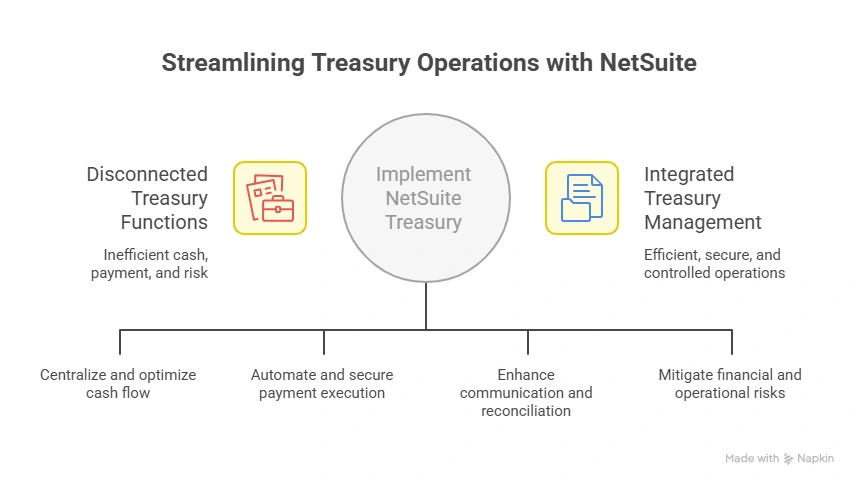
For businesses where treasury has meant a combination of manual bank reconciliations, FX spreadsheets, and reactive cash forecasts, NetSuite’s treasury capabilities represent a genuine operational shift.
For businesses that need enterprise-grade treasury management, multi-bank connectivity, sophisticated hedging, or real-time global cash pooling, NetSuite can integrate with dedicated Treasury Management Systems (TMS) like Kyriba or Trovata, which extend its native capabilities with specialist functionality.
To understand how treasury management fits inside the broader NetSuite financial management picture, our guide on mastering finance in the cloud with NetSuite financial management covers the full financial platform in context.
NetSuite Treasury Management Features NetSuite
Treasury Management is a software solution designed to help businesses manage their financial operations more effectively. It provides tools and features that help companies optimize their cash management, streamline financial reporting, and improve visibility into their financial data. Some of the key features of NetSuite Treasury Management include:
Cash Management and Visibility
NetSuite Treasury Management gives businesses better control over cash flow through tools that improve visibility and day-to-day cash operations. It helps finance teams monitor cash positions, forecast future needs, and make more informed financial decisions. This creates stronger liquidity management and reduces manual work.
Key capabilities include:
- Real-time cash positioning
- Cash flow forecasting
- Bank account management
- Improved liquidity visibility
- Reduced risk of financial fraud
Customized Financial Reporting
Financial reporting becomes easier with tools that allow businesses to generate reports tailored to their specific requirements. Teams can access more accurate financial data and gain deeper insights into overall performance. This supports better planning and faster decision-making.
Key capabilities include:
- Custom financial report creation
- Real-time financial insights
- Performance tracking and analysis
- Better visibility into financial health
- Data-driven decision support
Simplified Payment Processing
NetSuite Treasury Management streamlines payment operations by supporting multiple payment methods and centralizing payment workflows. Businesses can manage customer and vendor transactions more efficiently while improving overall cash movement and reducing delays.
Key capabilities include:
- ACH payment support
- Wire transfer processing
- Credit card payment handling
- Vendor and customer payment management
- Faster and more efficient transaction processing
Financial Risk Management Tools
Managing financial risk becomes easier with built-in tools designed to monitor and reduce exposure across different risk areas. Businesses can proactively respond to market changes and strengthen financial stability through better risk analysis and planning.
Key capabilities include:
- Currency risk management
- Interest rate risk monitoring
- Credit risk assessment
- Risk analysis and tracking
- Better financial stability and control
The Financial Risks NetSuite Treasury Management Addresses
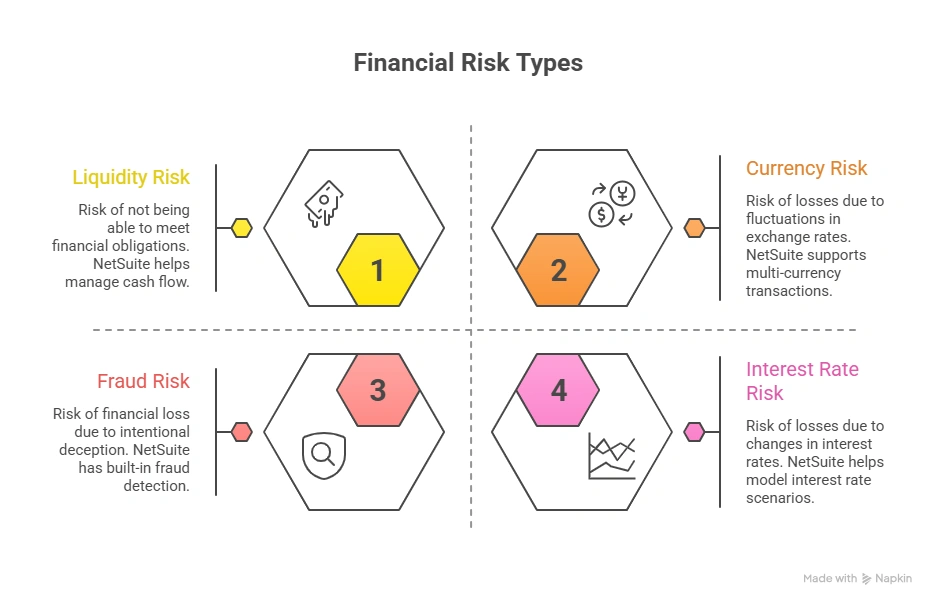
Liquidity Risk: Not Knowing Where Your Cash Actually Is
Liquidity risk sounds dramatic. In practice, it shows up quietly. A company has enough money in total but not enough in the right account at the right time. Payment runs get delayed. Vendors get paid late. A short-term borrowing need appears that could have been avoided with better visibility three weeks earlier.
NetSuite’s cash positioning tools give finance teams a real-time view of cash across all bank accounts, consolidated into a single dashboard. The cash forecast projects incoming and outgoing cash flows based on open invoices, scheduled payments, and historical patterns.
When these tools are working correctly, a CFO can look at a single screen on Monday morning and know, not guess, what the company’s liquidity position looks like for the next 30, 60, and 90 days. That is the baseline for every other treasury decision.
To go deeper on how NetSuite handles the specific mechanics of cash flow management, our guide on using NetSuite for cash flow improvement covers the practical tools in detail.
Currency Risk: Exposure That Grows With International Operations
The moment a business starts buying from international suppliers or selling to customers in other currencies, currency risk enters the picture. An invoice issued in euros, paid 45 days later, carries a risk that the exchange rate moves against you in that window.
NetSuite’s multi-currency capabilities handle the operational layer: transactions recorded in the correct currency, exchange rates updated automatically, and consolidated financials reporting accurately across subsidiaries. For businesses with significant FX exposure that need formal hedging programs or real-time rate analysis, integration with a specialist TMS extends this capability further.
The critical point is that currency risk cannot be managed reactively. By the time a finance team notices an FX exposure in a spreadsheet, the exposure has usually already affected the business. NetSuite’s real-time visibility means FX positions are visible as they develop, not after they have already moved.
Fraud Risk: Financial Controls That Run Automatically
71% of financial institutions are now using AI for fraud detection, up from 66% in 2023. That adoption rate reflects a real and growing threat. For mid-market businesses, the risks are just as real, even if the scale is smaller.
NetSuite addresses fraud risk through multiple layers. Role-based permissions control who can access financial data and approve transactions. Segregation of duties (SOD) controls prevent the same person from both creating and approving a payment. Automated approval workflows route transactions through the right sign-off chain based on value, vendor type, or account.
The audit trail tracks every transaction, every approval, and every change to a financial record. When something unusual happens, the history is there. When an auditor asks, the documentation is already organized.
What makes this different from a manual controls environment is that the controls run automatically. They do not depend on someone remembering to check a payment before it goes out. They are built into the workflow.
Interest Rate Risk: Visibility Into Debt and Investment Exposure
Businesses carrying variable-rate debt, or those managing short-term investment portfolios, face interest rate risk that changes as market conditions change. NetSuite provides the visibility layer: tracking outstanding debt obligations, interest schedules, and investment positions in a single financial view.
This visibility is the foundation of any meaningful interest rate risk strategy. You cannot model your exposure without knowing what you actually owe and at what rate. NetSuite keeps that data current and connected to the financial statements, so the analysis starts from accurate numbers.
Cash Forecasting and Scenario Planning: The Strategic Side of Treasury
Cash positioning tells you where you are. Cash forecasting tells you where you are going. For treasury management to genuinely reduce financial risk, both capabilities have to work together.
NetSuite’s cash forecasting draws on real data: open AR invoices, scheduled AP payments, recurring transactions, and historical patterns, to project cash positions forward. This is not a static spreadsheet built once a quarter. It is a rolling forecast that updates as transactions move through the system.
The scenario planning dimension is where treasury management becomes a strategic tool rather than a reporting exercise. A finance team with good cash forecasting can answer questions like: What happens to our liquidity position if one of our top three customers pays 30 days late? What does our cash look like if we accelerate that capital purchase? What are our options if we need to draw on the credit facility?
These are the questions that determine whether a business navigates a difficult quarter or gets caught by it.
To understand how working capital fits into the treasury picture and how NetSuite manages the balance between AR, AP, and cash, our guide on using NetSuite for working capital management covers the operational mechanics in detail.
How AI Is Changing Treasury Risk Management in NetSuite
The 2025 treasury landscape looks different from even two years ago. AI capabilities that were enterprise-only features are now part of the NetSuite platform, and they are changing what risk management looks like in practice.
Anomaly Detection in Financial Transactions
NetSuite’s built-in AI monitors financial transactions for patterns that deviate from normal behavior. Unusual spending amounts, transactions at unexpected times, payment requests to new accounts, and changes to vendor banking details all trigger alerts before any money moves.
This is meaningfully different from rule-based fraud detection. Rules catch what you anticipated. AI catches patterns you did not know to look for. AI analyzes multiple risk indicators simultaneously: unusual spending patterns, suspicious login locations, and unexpected changes in transaction frequency, in real time. The result is a faster response to genuine threats and fewer false positives wasting the team’s time.
Predictive Cash Flow Analysis
AI in NetSuite’s cash flow tools goes beyond extrapolating historical patterns. It identifies seasonal trends, customer payment behavior, and supplier payment cycles to produce forecasts that are more accurate than a simple trend projection. For businesses with irregular revenue patterns or large customers with variable payment timing, this accuracy matters in practice.
For a closer look at how NetSuite’s Cash 360 functionality specifically addresses cash flow visibility and management, our blog on how NetSuite Cash 360 helps organizations manage cash flow covers the tool in detail.
Compliance Monitoring
Regulatory requirements do not stand still. Staying current with tax changes, reporting requirements, and compliance standards across multiple jurisdictions is a real operational burden for finance teams.
NetSuite’s compliance capabilities automate the monitoring layer: tracking transactions against applicable rules, flagging potential compliance issues before they become penalties, and maintaining the audit trail that regulators and auditors require. This shifts compliance from a reactive exercise (cleaning up problems after an audit) to a proactive one (preventing the problems from materializing).
Payment Processing and Bank Relationship Management
Centralizing Payment Controls
One of the most direct ways treasury management reduces financial risk is by centralizing and standardizing how payments are processed. When payment runs happen in different systems, managed by different people, with different approval processes, the risk surface is large.
NetSuite consolidates payment processing across ACH transfers, wire payments, and credit card transactions. Approval workflows run automatically based on configured thresholds. Vendor banking details are controlled by permissions. The payment record is connected to the originating invoice and the general ledger entry.
This is not just an efficiency improvement. It is a control improvement. Fewer manual steps mean fewer points where something can go wrong.
Bank Account Management
NetSuite’s bank account management keeps bank account details, reconciliation status, and transaction history organized within the system. Bank reconciliation runs against imported bank statements, with matching logic that reduces the manual effort of line-by-line review.
For businesses managing multiple accounts across different banks or subsidiaries, this centralization means the finance team always knows which accounts are reconciled, which have unmatched transactions, and where the cash actually sits, without logging into each bank’s portal separately.
Connecting Treasury to the Rest of the Business
Treasury management is only as effective as the data feeding it. In NetSuite, treasury is not a standalone function. It is connected to the same data as your AR, AP, procurement, and operations.
When a large customer pays an invoice, the cash position updates immediately. When a purchase order is raised, the future payment obligation is visible in the cash forecast. When a new subsidiary is added to the OneWorld environment, its bank accounts and transactions flow into the consolidated treasury view.
This connection is what makes treasury management a real risk management capability rather than a retrospective reporting function. Risk is managed in real time because the data is in real time.
For businesses running NetSuite as their complete financial platform, including accounting, AR, AP, and financial reporting, our NetSuite for accounting page covers how the full financial management function works together.
When to Add a Dedicated TMS to NetSuite
NetSuite’s native treasury capabilities cover the needs of most mid-market businesses well. There are specific situations where integrating a dedicated Treasury Management System makes sense.
You should consider a TMS integration when:
- You manage cash across 10+ banking relationships and need automated bank connectivity at scale
- Your FX exposure requires formal hedging programs with derivative accounting
- You need real-time global cash pooling across multiple currencies and legal entities
- Your treasury team manages a significant investment portfolio requiring yield optimization tools
- Regulatory requirements in your industry mandate specialized treasury controls beyond what NetSuite handles natively
Solutions like Kyriba and Trovata integrate directly with NetSuite, with bidirectional data flows connecting treasury operations to the NetSuite general ledger. The ERP handles accounting, reporting, and operations. The TMS handles specialist treasury functions. Both systems stay current with each other automatically.
The right architecture depends on your specific treasury needs, your transaction volumes, and the complexity of your banking relationships. For most businesses, NetSuite’s native capabilities combined with solid financial process design, cover the risk management fundamentals.
Final Thoughts
Treasury management is where financial risk gets either managed or ignored. The difference between the two is usually not a shortage of information. It is a shortage of visibility into information that already exists in the business.
NetSuite’s treasury capabilities close that visibility gap by connecting cash management, payment controls, bank reconciliation, and risk monitoring to the same system running everything else in the business. When it is working correctly, a CFO does not spend the week before a credit renewal pulling data from seven different places. The data is current, connected, and already telling the story.
If you want to understand how to configure NetSuite’s treasury and financial management capabilities for your specific operation, get in touch with us today!
FAQs
What is NetSuite treasury management?
NetSuite treasury management refers to the cash management, payment processing, bank account management, and financial risk monitoring capabilities built into NetSuite’s financial management platform. It gives finance teams real-time visibility into cash positions, automates payment workflows with approval controls, manages bank reconciliation, and monitors financial transactions for anomalies and compliance issues.
What financial risks does NetSuite treasury management address?
NetSuite treasury management addresses four main financial risk categories. Liquidity risk, through real-time cash positioning and cash forecasting. Currency risk, through multi-currency transaction management and consolidated FX reporting. Fraud risk, through role-based permissions, segregation of duties controls, automated approval workflows, and AI-powered anomaly detection. Interest rate risk, through visibility into debt obligations and investment positions.
How does AI improve treasury risk management in NetSuite?
NetSuite’s embedded AI monitors financial transactions for unusual patterns in real time, flags potential fraud before money moves, and improves cash flow forecast accuracy by analyzing payment behavior patterns and seasonal trends. It also automates compliance monitoring by tracking transactions against applicable regulatory requirements and maintaining audit trails.
When should I add a dedicated Treasury Management System to NetSuite?
Consider a TMS integration when you manage 10 or more banking relationships requiring automated connectivity, run formal FX hedging programs, need real-time global cash pooling, manage a significant investment portfolio, or face regulatory requirements demanding specialized treasury controls. For most mid-market businesses, NetSuite’s native treasury capabilities cover the fundamentals well.
How does NetSuite treasury management connect to accounting?
NetSuite treasury management runs on the same platform as the general ledger, AR, AP, and financial reporting. Cash position updates are immediate when transactions post. Bank reconciliation connects directly to the GL. Cash forecasts draw from open AR invoices and scheduled AP payments. This native connection means treasury data informs real-time financial decisions rather than waiting for a manual reconciliation cycle.