Key Takeaways
- CPQ Customization Is Not a Feature Setup. It Is a Business Rules Decision: The most important CPQ configuration choices are not technical. They are about how your business actually prices, approves, and delivers what your sales team quotes.
- Configuration Rules Must Reflect Real Deals, Not Ideal Deals: CPQ that enforces rules your reps work around is worse than no CPQ at all. Adoption collapses when the system does not match how deals actually close.
- Pricing Logic Is the Highest-Risk Customization: Errors in pricing rules flow through to every quote, every order, and every invoice. Get this right before going live. Test it against your most complex historical deals.
- BOM Integration Is the Highest-Value Customization for Manufacturers: When CPQ generates a bill of materials automatically from a configured quote, the benefit extends well beyond sales. Manufacturing, procurement, and finance all receive more accurate, faster inputs.
- Industry Pattern Determines Configuration Priority: Manufacturing, SaaS, and professional services each need CPQ configured in a specific sequence. Starting with the wrong layer creates rework.
Businesses that use CPQ software reduce sales cycle time by 28% and improve quote accuracy by over 40%. Those numbers hold when CPQ is configured to match how the business actually sells. They disappear when the configuration was built around an ideal sales process that nobody follows.
That gap, between CPQ as configured and CPQ as used, is where most implementations fail. The rules are too rigid or too generic. Approval thresholds do not match the real authority structure. Proposal templates look polished but do not include the information customers actually ask for. Sales reps find workarounds. The system becomes expensive overhead instead of a sales asset.
The goal of CPQ customization is to encode how your business actually prices, configures, approves, and quotes, not how someone imagined you would operate when the module was purchased.
This guide covers the specific customization decisions that determine whether NetSuite CPQ works in practice, the order in which to make those decisions, and what the process looks like across three different business models: manufacturing, SaaS, and professional services.
What NetSuite CPQ Customization Actually Covers
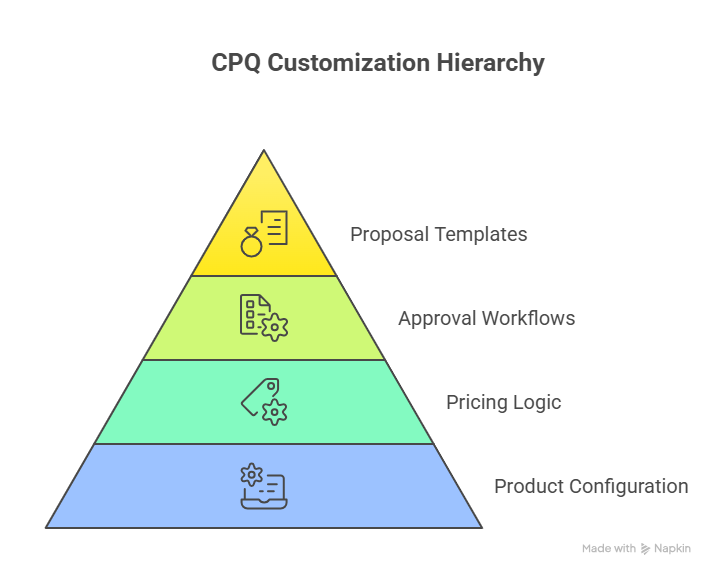
Before getting into configuration decisions, it helps to be precise about what customizing NetSuite CPQ means in practice. It is not writing code. For most businesses, it is four layers of configuration that determine how the system behaves.
Product Configuration Rules
The rules engine that defines what can be configured, what options are valid in combination with others, and what selections are required versus optional. A manufacturer of configurable server hardware might define that selecting a rack-mount chassis requires a minimum power supply specification. A professional services firm might define that a project engagement over a certain scope requires a senior consultant assignment.
Pricing Logic
The rules that determine how the price is calculated as options are selected. Volume discounts, customer-specific pricing, bundle discounts, margin floors, promotional pricing, and tiered pricing all live here. This is the highest-stakes layer. Errors in pricing logic compound across every quote.
Approval Workflows
The routing logic determines which deals require which approvals at what thresholds. A quote above a certain margin is routed to the sales manager. A deal above a certain total value routes to the CFO. An international quote routes to the legal and compliance team. Approval workflows that do not match real authority structures get ignored. Reps find ways around them. The control you thought you had does not exist.
Proposal and Document Templates
The branded output that customers receive. Fully customizable using Advanced PDF/HTML templates. The customization decision here is about content and layout: what information to include, how to present configuration choices, what level of detail to show, and how to handle line item presentation for complex configurations.
Why Most CPQ Customization Goes Wrong
Understanding the failure patterns keeps you from the most common and costly mistakes. Here is the CPQ Customization hierarchy that you need to understand to see how it actually works.
Rules That Reflect the Ideal, Not the Actual
The most frequent CPQ customization mistake is building configuration rules around how leadership thinks deals should work rather than how sales reps actually close them. If your pricing rules do not account for the negotiated exceptions that happen on 40% of your deals, reps will quote manually and use the CPQ output as a starting point rather than the source of truth. Adoption never reaches the level that makes CPQ worth the investment.
The fix is not to encode every exception. It is to review your last 50 closed deals before configuring pricing rules, identify the patterns in how discounts were actually applied, and build those patterns into the rules engine. Edge cases get handled through approval workflows, not by making the pricing engine so rigid that it cannot accommodate real selling.
Approval Workflows That Nobody Follows
Approval flows need to mirror your real authority structure so requests move through the right hands automatically. When the system reflects how your team already works, reps trust the workflow and use it consistently. When they do not, reps route deals outside the system, approvals happen via email, and the audit trail CPQ was supposed to create does not exist.
The most common misconfiguration is setting approval thresholds that are either too low (every deal triggers a manager approval, creating bottlenecks) or too high (the system approves deals that should have been reviewed). Map the thresholds against your actual approval data from the past 12 months before configuring.
Proposal Templates That Miss What Customers Ask For
A proposal template that looks polished but does not include the information a customer needs to say yes forces a follow-up conversation. That conversation delays the close. The customization decision for proposal templates should start with your sales team’s list of questions customers ask during the proposal stage, not with a design brief. Include the answers to those questions in the template. The design follows the content.
NetSuite CPQ Customization by Business Model
The right configuration sequence depends on your business model. These three patterns cover the most common scenarios.
Manufacturing: BOM Integration First
For manufacturers selling configurable products, the most valuable CPQ customization is not the customer-facing quote. It is the backend BOM generation.
NetSuite CPQ dynamically creates a bill of materials and routings based on built-in business logic in the rules engine, delivering BOM and routing instructions specific to the configured product to be produced with the correct materials and the right steps to complete the work order.
When a configured quote automatically generates the correct BOM, the benefit extends across the organization. Procurement knows exactly what to order. Manufacturing has the correct routing instructions. Finance can calculate actual cost of goods against the quoted margin. These downstream benefits disappear if the configuration rules are not tight enough to produce reliable BOM output.
Configuration priority for manufacturers:
- Define configurable items with option groups and dependency rules (what requires what, what excludes what)
- Map each configuration outcome to the correct BOM components
- Build pricing rules that reflect materials cost variation by configuration
- Set up approval workflows for custom configurations outside standard option groups
- Configure proposal templates that include manufacturing-relevant specifications for the customer’s approval
The Folio3 implementation for Doma States Tiles illustrates this sequence in a real manufacturing context. CPQ customization for a tile manufacturer with configurable dimensions, finishes, and quantities requires precisely this kind of BOM-first approach. For the full picture of what CPQ customization looks like for a complex product manufacturing operation, read the Doma States Tiles NetSuite customization success story.
SaaS and Subscription: Pricing Logic and Billing Integration First
For software and subscription businesses, the most important CPQ customization is the pricing logic and how it connects to billing. A SaaS company quoting an annual license with professional services onboarding and a support tier needs CPQ to handle three different billing models in a single quote, with each component converting correctly to the right billing schedule in NetSuite SuiteBilling.
The configuration complexity here is in the pricing rules: term length discounts, volume seat pricing, add-on pricing that changes based on base tier selection, and renewal pricing that differs from new business pricing. These rules need to be modeled precisely because they flow directly into revenue recognition and deferred revenue calculations.
Configuration priority for SaaS businesses:
- Define subscription products with term and tier options
- Build pricing rules for each tier, volume break, and term length
- Configure the quote-to-SuiteBilling conversion so each component lands in the correct billing schedule
- Set up approval workflows for discounts, free trials, and custom contract terms
- Build proposal templates that clearly present total contract value, annual recurring revenue, and payment schedule
Synthego, a biotech company with complex product configurations and pricing, represents the kind of precise CPQ configuration that life sciences and technology companies require. For the detailed implementation context, read the Synthego NetSuite success story.
Professional Services: Guided Selling and Approval Workflows First
For professional services businesses, the configuration challenge is different. Products are not physical items with option groups. They are service packages with scope variations, resource requirements, and dependencies between deliverables.
CPQ for professional services starts with guided selling: a structured questionnaire that leads a sales rep through scoping questions and outputs a recommended service configuration. The customization work is in designing the questions and the logic that maps answers to service packages and pricing.
Configuration priority for professional services:
- Map your most common engagement types to defined service packages
- Build the guided selling questionnaire that identifies which package fits a prospect’s needs
- Configure pricing rules for scope variations (number of users, project duration, geographic scope)
- Set up approval workflows for custom scopes and discounts
- Build proposal templates that include deliverables, timelines, and acceptance criteria
For consumer goods businesses that use a professional services model for key account management, CPQ configuration follows a similar pattern. The Sundia Corporation NetSuite success story covers a consumer goods implementation that required this kind of account-specific quote configuration.
The Six Customization Decisions That Determine CPQ Success
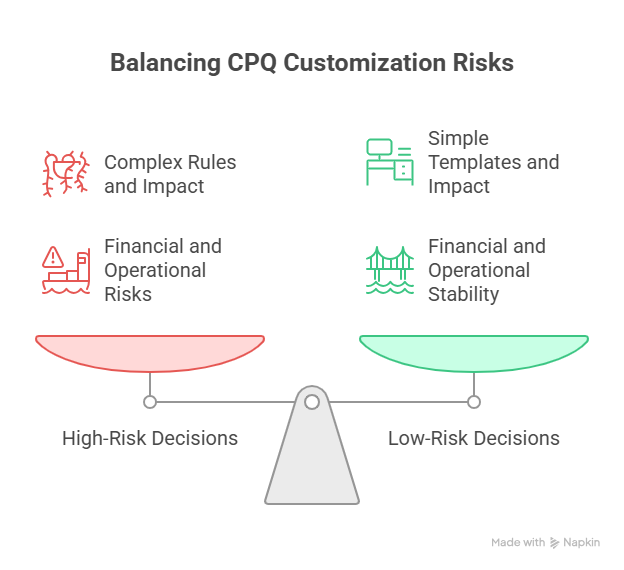
Regardless of business model, these six decisions shape whether NetSuite CPQ delivers value or overhead.
1. How to Structure Option Groups
Option groups are how you define what is configurable. A poorly structured option group creates configuration paths that do not map to real products. The right structure mirrors how your products are actually specified, not how they are organized in the catalog.
Rule of thumb: if a sales rep cannot explain an option group in one sentence, it is probably too complex. Simplify before coding the rule.
2. How Tight to Make Compatibility Rules
Compatibility rules prevent invalid configurations. Tight rules prevent errors but create friction when reps need to configure something outside the standard matrix. Loose rules let reps configure anything but produce quotes that operations cannot fulfill.
The right calibration is based on your manufacturing or delivery constraints. Rules should prevent what is physically or operationally impossible. They should route through approvals what is non-standard but possible. They should not try to prevent every exception, because that makes the system too rigid for real deals.
3. How to Handle Margin Floors
Margin floor rules prevent sales reps from quoting below minimum acceptable margins. Margin protection rules prevent sales reps from quoting below minimum margins. The system can enforce floor prices or require management approval for discounts that exceed thresholds.
The configuration decision is whether to hard-stop below the floor or route to approval. Hard stops protect margins but can frustrate reps on strategic deals. Approval routing protects margins while preserving flexibility. For most businesses, approval routing for deals below a margin threshold is the right balance.
4. How Many Approval Tiers to Build
Every additional approval tier adds time to the quote cycle. Each tier should exist because there is a genuine business reason for that level of review at that threshold. Start with two tiers (sales manager and executive) and add tiers only when you can identify a specific deal type that requires a distinct approver.
Businesses that start with five approval tiers because it seemed thorough typically end up with three tiers being ignored within six months because reps avoid triggering them.
5. What to Include in Proposal Templates
The proposal template is often the only thing the customer sees from your CPQ implementation. It needs to include everything required to get a signature without a follow-up call. That means: what they are buying, what it costs, what they are agreeing to, and what happens next.
Customization here is about removing everything that does not help the customer make a decision, and adding everything they will ask for in a follow-up. The template should be tested on three or four real proposals before going live.
6. How CPQ Connects to Order Management Downstream
When a customer accepts a quote, the configuration needs to convert cleanly to a sales order. The customization decision here is about field mapping: which fields on the quote record carry over to the order, which configuration options translate to specific line items, and how BOM or subscription details populate the order correctly.
A finished CPQ quote does not stop at the signature. The data flows downstream into sales orders and operational processes, which reduces re-entry and handoff errors throughout the rest of the deal. Poor field mapping at this stage creates the exact manual re-entry problem CPQ was supposed to eliminate.
For businesses where NetSuite customization goes deeper than CPQ, covering workflow automation, custom records, SuiteScript scripting, and integration configuration, our NetSuite customization services cover the full scope.
How to Test CPQ Customization Before Go-Live
CPQ configuration is only proven by running real deals through it. Testing against theoretical scenarios misses the edge cases that real deals always contain.
The right testing approach is to take your 10 most complex historical deals, the deals with the most unusual configurations, the deepest discounts, or the longest approval chains, and run each one through the configured system. For each deal, ask three questions:
- Does the system produce the correct configuration? (Are the right options available? Do the constraints prevent the right invalid combinations?)
- Does the system produce the correct price? (Do volume discounts, customer-specific pricing, and bundle rules produce the price that was actually quoted?)
- Does the approval workflow route correctly? (Do the right approvers get notified? Does the audit trail capture the right information?)
If the system produces incorrect results on any of your 10 most complex historical deals, those are bugs in the configuration that will appear again in live deals. Fix them before go-live, not after a customer receives a wrong quote.
Final Thoughts
NetSuite CPQ customization is not a one-time setup. It is an ongoing alignment between how the system is configured and how the business actually sells. Markets change. Products evolve. Pricing strategies shift. The CPQ configuration needs to reflect those changes or adoption erodes.
The businesses that get the most from CPQ treat the configuration as a living operational decision, reviewed and adjusted when pricing strategy changes, when product lines expand, or when approval processes evolve.
Folio3’s customization practice works with manufacturers, biotech companies, consumer goods businesses, and professional services firms to configure NetSuite CPQ in ways that reflect real selling, not theoretical selling. If you want a straight answer on what the right customization approach looks like for your specific products and sales model, reach out to the team.
FAQs
What is NetSuite CPQ customization?
NetSuite CPQ customization is the process of configuring the product rules engine, pricing logic, approval workflows, and proposal templates to match how your business actually sells. It is not primarily a coding exercise. Most CPQ customization is done through the configuration interface, with SuiteScript scripting used for edge cases that require custom logic beyond the standard rules engine.
How long does NetSuite CPQ customization take?
For a straightforward product catalog with moderate complexity, four to eight weeks cover configuration, testing, and training. For complex manufacturing environments with BOM integration or subscription businesses with SuiteBilling connections, eight to sixteen weeks is more realistic. The variable is the complexity of the pricing rules and the number of configuration paths that need to be validated.
What is the most important CPQ customization to get right?
Pricing logic. Errors in the pricing rules engine produce incorrect quotes that damage customer trust, compress margins, and create downstream billing problems. Every other customization can be adjusted post-go-live with relatively minor impact. Pricing errors that have gone to customers require correction conversations that nobody wants to have.
Can NetSuite CPQ handle complex manufacturing configurations?
Yes, for moderate to moderately complex configurations. NetSuite CPQ handles well-structured option groups, dependency rules, BOM generation, and routing instructions for products with clearly definable configuration paths. For products with hundreds of interdependent options, deep engineering-to-order complexity, or visual rendering requirements, specialist CPQ tools (Oracle CPQ Cloud, Salesforce CPQ) may be more appropriate, connected to NetSuite via integration.
What is the difference between CPQ guided selling and the product configurator?
The product configurator handles complex configurable products where sales reps or customers make selections from defined option groups, with rules validating each choice. Guided selling uses a questionnaire format, asking questions and using the answers to recommend appropriate products or configurations. Guided selling works better when the product selection decision is made before configuration begins. The configurator works better when the customer has already decided on the product and needs to specify it.