Key Takeaways
- SuiteAnswers Is NetSuite’s Self-Service Knowledge Center: With over 50,000 searchable resources, it covers how-to questions, best practices, help documentation, and training videos, all in one place.
- There Are Four Distinct Content Types: Support Articles answer procedural questions. Best Practices come from NetSuite’s own consulting team. Help Topics are the official product documentation. Training Videos demonstrate tasks step by step. Knowing which to search for saves time.
- NetSuite Expert Changed How Search Works: The AI-powered search layer now summarizes answers to natural language questions directly. You do not need exact terminology. You can ask the way you think.
- Filters Are What Separate Useful Results From Noise: Filtering by content type, product category, and target audience cuts a wall of results down to the handful that actually apply to your situation.
- SuiteAnswers and the Inline Help Center Are Different Tools: The Help Center answers questions about the page you are on. SuiteAnswers searches the full knowledge base across all topics and products.
- Escalation Has a Clear Threshold: If three targeted searches return nothing usable, submit a support case directly from SuiteAnswers. The case form pulls your account context automatically.
How many hours has your team spent waiting for a support response to a question that turned out to have a published answer sitting in NetSuite’s knowledge base?
It happens more than most teams realize. Not because SuiteAnswers does not have the answer, it almost always does. It happens because most users do not know how to search it effectively. They type a vague phrase, get back fifty results, skim the first three, find nothing useful, and submit a support ticket. The support team responds two days later with a link to the exact SuiteAnswers article that already existed.
We see this pattern repeatedly with teams that are new to NetSuite and with teams that have been using it for years. SuiteAnswers is one of the most underused resources in the entire NetSuite ecosystem. This guide covers what it contains, how to reach it, how to search it well, and how to know when to stop searching and call for help.
What Is NetSuite SuiteAnswers?
SuiteAnswers is a searchable knowledge center of rich support articles, best practices, help topics, and training videos, available to all NetSuite customers and partners. It is the primary self-service support resource for NetSuite, the place to go before submitting a ticket, before calling your partner, and before posting a question in a forum.
Think of it as a library organized around NetSuite’s full product surface. Every module, every feature, every common workflow has documentation in SuiteAnswers. The challenge is not whether the content exists. It is knowing how to find the specific piece that answers your specific question.
SuiteAnswers sits on top of NetSuite’s broader support infrastructure. It is connected to your account, which means when you eventually need to submit a support case, the case form pulls your account context automatically. No need to describe your environment from scratch.
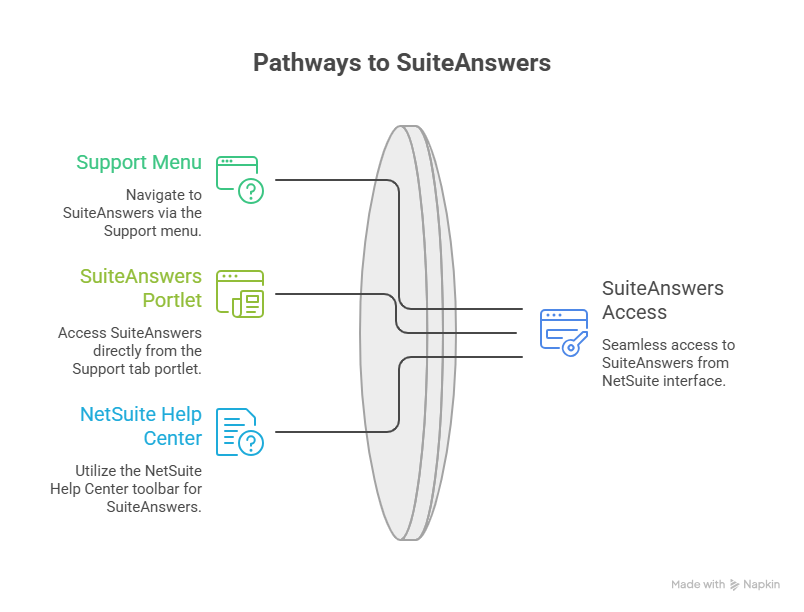
How to Access SuiteAnswers
There are three ways to get to SuiteAnswers from inside NetSuite.
From the Support Menu Hover over the Support tab in the top navigation bar and click Go to SuiteAnswers from the dropdown. This is the most direct route for most users.
From the Support Tab Portlet The Support tab on your NetSuite home page includes a SuiteAnswers portlet. Click Go to SuiteAnswers from there. If you use the Support tab regularly, this becomes the fastest entry point.
From the Inline Help Center When you are working in a specific module and click the Help icon, the Help Center opens inline. There is a SuiteAnswers link in the toolbar. This takes you to SuiteAnswers pre-filtered to content related to the area you were working in, often a faster starting point than a blank search.
The Four Content Types in SuiteAnswers
Understanding what each content type is designed for changes how you search. Most users treat all results as equivalent. They are not.
Support Articles
Support Articles address “how do I” questions and often provide step-by-step instructions for unique solutions. These are the workhorses of SuiteAnswers. If you are trying to understand how to configure a specific feature, how to create a particular type of record, or how to resolve a common error message, Support Articles are where to start.
They are written for practical use. They include screenshots, navigation paths, field-by-field instructions, and in many cases, links to related articles that address adjacent questions. When a Support Article exists for your question, it is almost always faster than calling support.
Best Practices
Best Practices orient project team members to the proven steps and methods used by NetSuite’s SuiteConsulting team. These are not how-to guides. They are recommendations for how to approach a process, the methodology behind a configuration decision, not the click-by-click instructions.
Best Practices are most useful during implementation, during a configuration review, or when you are deciding between two approaches and want to know which one NetSuite recommends. If a Support Article tells you how to do something, a Best Practice tells you whether you should do it that way and what to consider first.
Help Topics
Help Topics provide easy access to NetSuite’s extensive help documentation. These are the product’s official reference documentation, comprehensive descriptions of every field, every setting, every option in a given area of NetSuite. They are what the inline Help Center draws from.
Help Topics are most useful when you need to understand what a field does, what the valid values are, or what a specific feature is designed to handle. They are thorough but not task-oriented. Use them when you are learning, auditing, or need a complete picture rather than a quick answer.
Training Videos
Training Videos provide visual training and demonstration on core NetSuite administration and end-user tasks. These are short video walkthroughs, typically under ten minutes, that show a feature or workflow in action.
Training Videos are the right starting point for users who are new to a module, onboarding team members to a specific workflow, or trying to understand something that is easier to watch than read. They do not replace the depth of a Support Article but they are far more accessible for users who are not yet familiar with how NetSuite organizes a particular area.
How to Search SuiteAnswers Effectively
Most users type one or two words into the search bar and scroll through results. That works for generic topics. It does not work when you need something specific. These habits change the quality of results significantly.
Use NetSuite Expert for Natural Language Questions
The look of SuiteAnswers has not changed, but how search works has. You can still search SuiteAnswers like you always have, but results from NetSuite Expert in SuiteAnswers are more helpful when you ask a question.
NetSuite Expert is the AI-powered layer built into SuiteAnswers. Instead of keyword matching, it reads your question and summarizes a relevant answer directly in the results. You do not need to know the exact technical term. Asking “how do I set a minimum reorder quantity for an item” works better than typing “reorder quantity minimum field.”
Enter a question or phrase with at least three words into the search field. NetSuite Expert in SuiteAnswers works with natural language search. It is not a chat application. Do not enter complicated scenarios or try to have a back-and-forth conversation.
One practical tip: include the product or module name in your question. “How do I configure approval routing in SuiteApprovals?” returns tighter results than “how do I set up approvals.” The more specific the question, the more specific the summary.
Filter Results Before You Scroll
After running a search, apply filters before reading any results. The filter panel on the left side of SuiteAnswers lets you narrow by content type (Support Articles, Best Practices, Help Topics, Training Videos), product category (which module or feature area), and target audience (administrator, end user, developer).
Most users who get frustrated with SuiteAnswers are actually getting good results. They are just not filtering. A search for “bank reconciliation” returns results across all content types, all modules, and all audiences. Filtering to Support Articles and the Banking product category cuts that list down quickly.
Search for Error Messages Exactly
When you encounter a specific error message in NetSuite, paste the exact error text into SuiteAnswers, quotes and all. Error messages are often documented with their exact phrasing in Support Articles. A search for the precise text returns the right article far more reliably than a paraphrase.
Use the Product Category Filter for Module-Specific Questions
If your question is about a specific module, SuiteBilling, SuiteProjects, Field Service Management, or OpenAir, filter by that product category before searching. It removes results from other modules that may use the same terminology with different meanings.
For users working with NetSuite OpenAir specifically, applying the OpenAir product category filter in SuiteAnswers surfaces documentation that is specific to the professional services platform rather than the core ERP.
SuiteAnswers vs. the Inline Help Center: What Is the Difference?
Both tools exist to answer questions. They serve different moments.
The inline Help Center is context-sensitive. When you open it, it shows documentation relevant to the page or record you are currently working on. It is the right tool for quick field-level questions: what does this checkbox do, what format does this field expect, what happens when I enable this setting. The inline Help Center draws from the same Help Topics that live in SuiteAnswers, but it filters automatically by context.
SuiteAnswers is the full knowledge base without contextual filtering. It includes everything in the Help Center plus Support Articles, Best Practices, and Training Videos. It also has the NetSuite Expert AI search layer. Use SuiteAnswers when you have a task-level question (“how do I set up automated bank feeds”), a process question (“what are the best practices for period close”), or when the inline Help Center does not have what you need.
The practical rule: start with the inline Help Center for field-level questions. Switch to SuiteAnswers for anything more complex.
When to Escalate From SuiteAnswers to a Support Case
SuiteAnswers is the right first stop. It is not always the last stop. These are the signals that it is time to submit a case.
Three targeted searches returned nothing actionable. If you have searched with specific terminology, filtered by content type and product, and tried NetSuite Expert with a natural language question, and still have not found an answer, the issue is likely unusual enough to warrant direct support.
The article exists but the steps do not match what you see. NetSuite releases updates twice per year. Documentation occasionally lags behind the interface. If a Support Article describes a workflow that does not match what you see in your account, submit a case with a screenshot of the discrepancy.
The error is account-specific. If SuiteAnswers describes a known error and its resolution, but the resolution does not work in your account, the issue may be in your account configuration rather than in the standard product. That requires a support case with access to your account data.
You need confirmation before making a change. For high-stakes changes, enabling features, modifying accounting preferences, changing permissions for active users, it is worth a support case to confirm the approach before executing, even if SuiteAnswers has documentation on the steps.
Submitting a case from inside SuiteAnswers is faster than submitting from the main Support menu because SuiteAnswers pre-attaches your account information and search history to the case, giving the support team context before they open it.
How SuiteAnswers Fits Into the Broader NetSuite Support Ecosystem
SuiteAnswers is one layer of a broader support structure. Understanding where it sits helps you know what to reach for first.
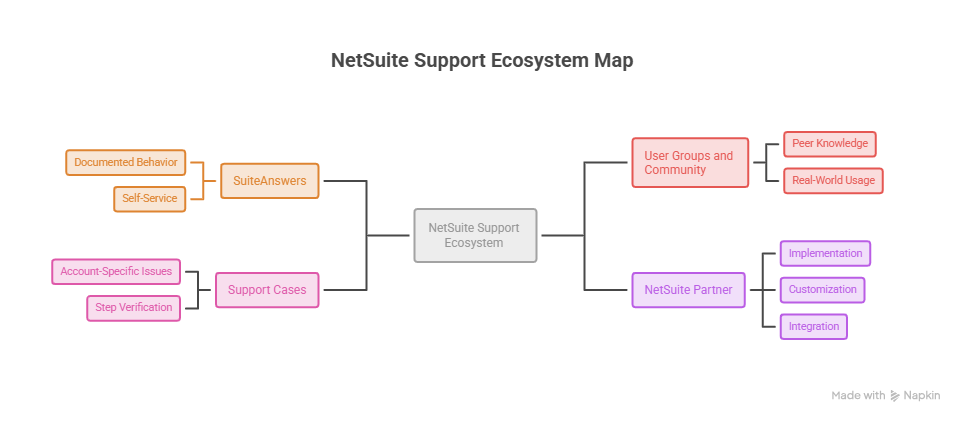
SuiteAnswers covers documented, known product behavior. It is the right tool for any question that has a published answer.
NetSuite User Groups are the right place for questions that require community context, how other businesses handle a process, whether a workaround exists, and how a feature is used in practice rather than as documented. NetSuite user groups connect you to practitioners across industries who have solved the same problems you are facing.
The Vendor Center and Partner Resources are relevant when questions involve how NetSuite is presented to or accessed by external parties. NetSuite’s Vendor Center has its own documentation layer, and vendors accessing the portal have a different support path than internal users.
Your NetSuite Partner handles implementation-level questions, configuration decisions, customizations, integrations, and anything that requires access to your account at an admin level. SuiteAnswers tells you what NetSuite can do. Your partner helps you figure out what it should do for your specific situation.
Final Thoughts
SuiteAnswers is not a backup option for when support is slow. It is the first tool you should reach for, not because submitting a ticket is wrong, but because most questions that hit the support queue already have a published answer waiting in the knowledge base.
The teams that use SuiteAnswers well are the ones that have learned to search specifically, filter by content type, and use NetSuite Expert for questions they would have phrased conversationally to a colleague. The platform has the content. The skill is in how you ask for it.
If your team is still defaulting to support tickets for questions that SuiteAnswers can answer, building a short internal guide on how to search effectively is one of the highest-return investments you can make in your team’s NetSuite fluency.
FAQs
What is NetSuite SuiteAnswers?
NetSuite SuiteAnswers is a self-service knowledge center available to all NetSuite customers and partners. It contains over 50,000 resources across four content types: Support Articles, Best Practices, Help Topics, and Training Videos. It is the primary resource for resolving how-to questions, understanding feature behavior, and finding implementation guidance without submitting a support case.
Is SuiteAnswers free to use?
Yes. SuiteAnswers is available to all NetSuite customers and partners as part of the standard NetSuite subscription. There is no additional license required.
How do I access SuiteAnswers in NetSuite?
Navigate to the Support tab in the top navigation bar and click Go to SuiteAnswers. You can also access it from the SuiteAnswers portlet on the Support tab or from the toolbar in the inline Help Center.
What is NetSuite Expert in SuiteAnswers?
NetSuite Expert is the AI-powered search layer built into SuiteAnswers. It processes natural language questions and returns a summarized answer drawn from the knowledge base, rather than just a list of matching documents. You access it by typing a question of at least three words into the SuiteAnswers search bar.
What is the difference between SuiteAnswers and the NetSuite Help Center?
The inline Help Center is context-sensitive. It shows documentation relevant to the page or record you are currently working on. SuiteAnswers is the full knowledge base without contextual filtering, and it includes Support Articles, Best Practices, and Training Videos in addition to the Help Topics that the inline Help Center draws from. Use the Help Center for quick field-level questions and SuiteAnswers for task-level or process-level questions.
When should I submit a support case instead of using SuiteAnswers?
Submit a case when three targeted searches have returned nothing actionable, when a documented solution does not work in your specific account, when an error appears to be account-specific rather than a known product issue, or when you want confirmation before making a high-stakes configuration change.